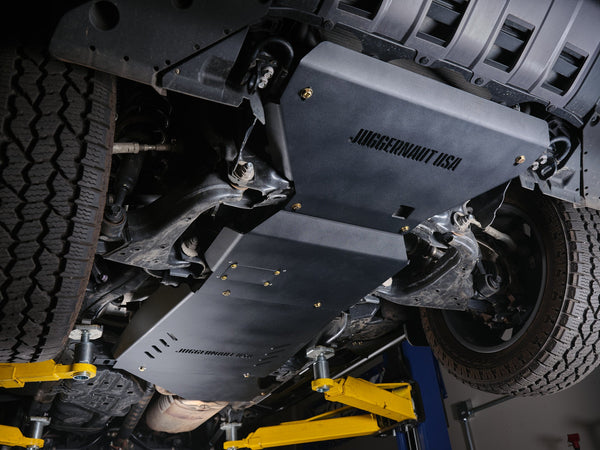
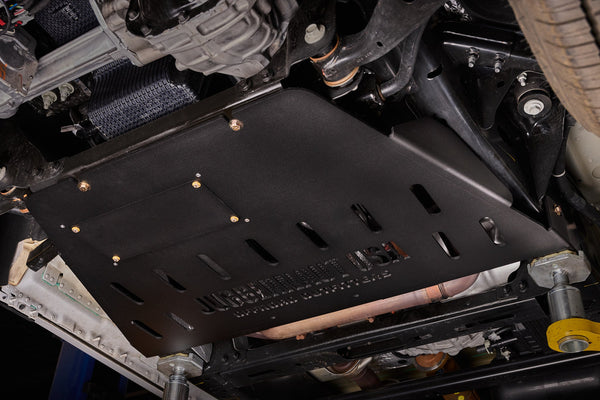
Aluminum vs. Steel Skid Plates: The Honest, Data-Backed Comparison.
For most trucks and vans, 1/4″ 5052-H32 aluminum wins: it matches 3/16″ steel's bending strength at roughly half the weight and never rusts. Steel only makes sense for constant rock-crawling abrasion on a budget.
Thickness-for-thickness steel is stronger. Weight-for-weight aluminum wins.
Resistance to permanent bending scales with the square of thickness, so doubling thickness gets you roughly four times the stiffness — which is why 1/4″ aluminum out-resists 3/16″ steel at roughly half the weight, and does not rust where the coating chips.
Steel's real advantage is surface hardness against repeated abrasion on rock. In either material, 1/8″ or below is a debris cover rather than armor.
Aluminum vs. steel skid plates comes down to four numbers: yield strength, thickness, weight, and corrosion. Run them honestly and a 1/4″ 5052-H32 aluminum plate beats a 3/16″ steel plate where it counts — it takes more force to permanently bend, at roughly half the weight, and it can’t rust. Steel still has a place, and we’ll be straight about where. We manufacture our own 1/4″ aluminum skid plates in Colorado, so this is the comparison we’d give a customer at the bench.
Jump to the strength numbers, salt-spray corrosion, weight, or the honest verdict.
The short answer
- Per square inch of material, steel is stronger. Mild A36 steel yields around 36,000 psi vs ~28,000 psi for 5052-H32 aluminum. We won’t pretend otherwise.
- But a skid plate isn’t a square inch — it’s a panel that resists bending, and bending resistance scales with the SQUARE of thickness. At a real 1/4″ aluminum vs 3/16″ steel, the aluminum takes about 38% more force to permanently bend.
- And it does it at ~54% less weight (~3.5 vs ~7.7 lb/ft²) — weight you keep as payload and fuel economy.
- Aluminum can’t rust. Steel’s corrosion resistance lives entirely in its coating, which a single trail rock defeats.
- Steel wins if you grind rocks hard every weekend (better abrasion resistance) and you want the cheapest option and don’t mind rust and weight.
Watch: we run the actual math — yield strength, thickness, and what 1/4″ aluminum vs 3/16″ steel really works out to.
Strength: yield, thickness, and what actually bends
The most common myth is "steel is stronger, so a steel skid plate is stronger." The first half is true at the material level; the second half ignores thickness.
| Property | 1/4″ 5052-H32 Aluminum (ours) | 3/16″ Steel (mild / A36) |
|---|---|---|
| Material yield strength | ~28,000 psi (193 MPa) | ~36,000 psi (250 MPa) |
| Plate thickness | 0.250″ | 0.1875″ |
| Force to permanently bend the plate* | ~38% higher | baseline |
| Weight | ~3.5 lb/ft² | ~7.7 lb/ft² |
| Rust | Cannot rust | Rusts once coating is breached |
*A plate resists bending by its section modulus, which scales with thickness squared. The load to reach yield is proportional to (yield strength × thickness²). For 1/4″ aluminum that’s 28,000 × 0.250² ≈ 1,750; for 3/16″ mild steel it’s 36,000 × 0.1875² ≈ 1,266 — about 38% more resistance for the aluminum plate. The extra thickness more than offsets steel’s higher material yield.
In plain terms: steel is a stronger material, but our 1/4″ aluminum plate is a stronger skid plate than a 3/16″ steel one against the strikes that actually deform underbody armor — and it weighs about half as much.

Corrosion: the salt-spray reality
The industry corrosion benchmark is ASTM B117 salt-fog testing — parts sit in a continuous 5% salt mist at 95°F and you measure when rust appears.
- Bare mild / cold-rolled steel shows rust in ~24–48 hours. In a published 200-hour salt-spray chamber test by hardware manufacturer Co-Mac, plain steel parts were rusting within the first hour and completely rusted over at 50 hours — while the aluminum parts in the same chamber still showed no rust at 125 hours and were in good condition when the test ended at 200.
- Coated steel (a quality powder-coat or e-coat) buys more time — often a few hundred hours to first rust at a scribe — but only until the coating is breached.
- 5052-H32 aluminum produced no rust through the full 200-hour published test. It forms a thin, self-healing oxide layer — it’s the marine-grade alloy used for boat hulls in saltwater. The failure mode simply doesn’t exist.
Here’s why that matters for a skid plate specifically: your underbody lives in salt, mud, and standing water, and a single rock scratch on the trail breaches a steel plate’s coating. From that point, the bare steel underneath rusts and keeps rusting. Scratch aluminum all you want — it stays corrosion-resistant, because the protection is the metal itself, not a coating that chips.
Weight: payload and the parts you can’t see
A 1/4″ aluminum plate weighs roughly 3.5 lb/ft² against about 7.7 lb/ft² for 3/16″ steel — a little over half. On a full underbody package that’s tens of pounds. On a truck or van, weight is payload you can legally carry and fuel economy you keep; on a van especially, every pound of armor is a pound off your cargo rating. It also sits low and forward, where added mass works against handling.
Impact: flex vs. crack
Beyond the static numbers, the two materials fail differently. 5052-H32 aluminum flexes and absorbs a hit, then springs back. Steel is harder, so it resists abrasion better — but on a sharp, concentrated strike it’s more likely to either dent permanently or transfer the shock straight into the frame mounts and weld points. The aluminum’s give is a feature: it takes the energy and recovers, instead of cracking at a weld or loading your mounting points.
Where steel actually wins
Two honest advantages:
- Abrasion. If you drag the same plates across granite slickrock every single weekend, steel’s hardness shrugs off that grinding wear a little better over time.
- Price. Steel is cheaper raw material, so a budget steel skid plate can cost less up front.
If you’re a hardcore rock-crawler who grinds metal on rock constantly and you genuinely don’t mind the rust and the weight, steel is a defensible choice. For the other 95% of truck, van, and overland owners, aluminum is the better all-around plate.
But what about 1/4″ steel?
Fair question — this comparison uses 3/16″ steel because that’s what almost every steel skid plate actually is. So why not match our 1/4″ aluminum against 1/4″ steel? Inch for inch, yes: 1/4″ steel is stronger and more bend-resistant than 1/4″ aluminum. But it weighs roughly twice as much (~10+ lb/ft²), it still rusts the moment its coating is breached, and that mass hangs low and forward where it hurts handling and payload most. That’s exactly why you’ll almost never see a 1/4″ steel skid plate sold — it’s far more weight than the protection justifies. The real, buildable choice is 1/4″ aluminum vs 3/16″ steel, and there aluminum wins on strength, weight, and corrosion at the same time.
Which should you choose?
| If you... | Choose |
|---|---|
| Daily-drive, overland, tow, or run a van — and want to bolt it on once and forget it | 1/4″ aluminum |
| Live in the salt belt or anywhere wet | 1/4″ aluminum (steel rusts once scratched) |
| Care about payload / fuel economy | 1/4″ aluminum (~half the weight) |
| Grind rocks hard every weekend and don’t mind rust + weight | Heavy steel is defensible |
| Want the cheapest possible plate up front | Budget steel |
Why 5052-H32 specifically
"Aluminum" isn’t one thing. We use 5052-H32 — a marine-grade alloy used for boat hulls — because it’s the best balance of strength, corrosion resistance, and the ability to flex without cracking. A softer alloy like 3003 dents too easily. Higher-strength alloys win on a spec sheet but lose where it counts: 6061 is more prone to cracking at the bends and welds and is less corrosion-resistant, and aerospace-grade 7075 (yield ~73,000 psi) is stronger still but brittle — it can’t be press-brake folded or welded without cracking, it cracks on a hard impact instead of flexing back, and it corrodes faster in salt. 5052-H32 is the sweet spot: it takes a hit, deforms, and keeps going, and it laughs at salt water.
Our plates
Juggernaut USA skid plates are CNC plasma-cut from 1/4″ 5052-H32 aluminum, press-brake folded, powder-coated, and bolt on to factory mounting points with no drilling — made in the USA in Wheat Ridge, Colorado, with a lifetime warranty. Browse by platform in the truck skid plates and van skid plates collections — including Super Duty, Ram ProMaster, and Mercedes Sprinter packages — or read our catalytic converter theft protection guide if cat-shield coverage is what you’re after.

Frequently asked questions
Is aluminum or steel better for skid plates?
For most owners, 1/4″ 5052-H32 aluminum. At that thickness it resists bending about 38% better than a 3/16″ steel plate, weighs roughly half, and can’t rust. Steel is harder and cheaper, which suits constant rock-grinding on a budget if you don’t mind the rust and weight.
Isn’t steel stronger than aluminum?
As a raw material per square inch, yes — A36 steel yields ~36,000 psi vs ~28,000 psi for 5052-H32. But a skid plate’s resistance to bending scales with thickness squared, so a 1/4″ aluminum plate is harder to permanently bend than a 3/16″ steel one.
Does aluminum rust?
No — aluminum cannot rust. 5052-H32 is marine-grade and forms a self-healing oxide layer. In salt-spray testing, bare steel rusts in 24–48 hours, while 5052 showed no rust through the full 200-hour published test. Steel rusts as soon as a rock breaches its coating.
Will a 1/4″ aluminum plate dent or crack on a hard hit?
5052-H32 flexes and absorbs the impact rather than cracking at a weld or transferring shock into the frame mounts. It can take a cosmetic dent on an extreme strike, but it keeps protecting.
How much lighter is aluminum?
A 1/4″ aluminum plate is roughly 54% lighter than a 3/16″ steel plate (~3.5 vs ~7.7 lb/ft²) — meaningful payload and fuel-economy savings across a full package.
Is 1/4 inch aluminum strong enough for a skid plate?
Yes. At 1/4″, 5052-H32 aluminum resists bending about 38% better than a 3/16″ steel plate and absorbs impacts by flexing rather than cracking. It’s the thickness we build every Juggernaut plate from.
What thickness of steel matches 1/4 inch aluminum?
Roughly 1/4″ steel matches 1/4″ aluminum for bend resistance — but that’s about twice the weight and it still rusts, which is why almost no one builds skid plates from 1/4″ steel. Most steel skids are 3/16″ or thinner, which our 1/4″ aluminum out-resists.
Is 5052 or 6061 aluminum better for skid plates?
5052-H32. 6061 is slightly stronger but less corrosion-resistant and more prone to cracking at bends and welds. 5052-H32 is the marine-grade alloy that flexes without cracking — the right choice for formed-and-welded underbody armor.
Is 7075 aluminum better than 5052 for skid plates?
No. 7075 is one of the strongest aluminum alloys (yield ~73,000 psi), but it’s the wrong tool for a skid plate: it’s brittle and cracks on impact instead of flexing, it can’t be press-brake folded or reliably welded without cracking, and it’s less corrosion-resistant than 5052. A skid plate needs to bend and absorb hits, not shatter — which is why we build with 5052-H32, not 7075.
Do aluminum skid plates hold up to rock crawling?
For the vast majority of trail use, yes — 1/4″ 5052 takes repeated hits and flexes back. The one place heavy steel edges it out is constant abrasive grinding on slickrock; see "Where steel actually wins" above.
Does aluminum or steel better protect a catalytic converter?
Either material physically blocks a saw, but a 1/4″ aluminum cat shield bolts on, won’t rust, and adds minimal weight. See our catalytic converter theft protection guide for fitment and coverage.
Get protected
Shop 1/4″ aluminum skid plates for your platform — made in Colorado, bolt-on, lifetime warranty. Not sure which plate fits your exact year and trim? Email sales@juggernautusa.com or call (970) 341-4221 and we’ll confirm fitment before you buy.
Sources
- ASTM B117 — Standard Practice for Operating Salt Spray (Fog) Apparatus — the industry salt-fog test standard.
- Co-Mac — Salt Spray Testing for Corrosion Resistance (2020) — 200-hour chamber test of plain steel, aluminum, and stainless hardware, with photos.
- MatWeb — Aluminum 5052-H32 datasheet — 28,000 psi typical yield and density (Aluminum Association data).
- AZoM — ASTM A36 mild steel properties — ~36,300 psi yield strength.
- Hydro — Strength and corrosion resistance with aluminium alloy 5052 — marine/saltwater corrosion behavior.
Steel still has a place For constant hard rock-grinding on a budget, heavy steel is defensible. For everyone else — daily drivers, overlanders, vans, salt-belt trucks — 1/4″ aluminum is the better all-around plate.
Tell us your year, make, and model — we'll confirm fitment and quote parts + professional install.