Ford Transit Underbody Protection: What's Exposed and What Actually Protects It (2015–2026).
The Transit hangs an intercooler, oil pan and two catalytic converters low enough to matter, and Ford covers none of it. What's exposed, what the factory gives you, and an honest comparison of every skid plate on the market — including the components none of them protect.
There is no factory skid plate package on any Transit configuration, AWD included. The intercooler, oil pan and both catalytic converters all hang low enough to matter.
The intercooler is the one most commonly damaged.
The plates on the market cover different things: Van Compass is the only one built around the intercooler, ASFIR is the thickest, and none of them protect the converters — that needs a separate cat shield.
The Ford Transit has a problem most vans don't: there is a lot down there, and almost none of it is protected.
Oil pan, transmission housing, oil and water lines, an intercooler that sits lower than people expect, and catalytic converters that have made this van one of the more commonly targeted vehicles in the country. The 2020+ AWD adds a front driveline to that list.
This is what is actually underneath a 2015–2026 Transit, what Ford does and does not cover, and an honest look at what the aftermarket offers — including where a competitor's plate is the better buy today, and where ours fits.
Last verified July 2026.
Jump to: What's exposed · RWD vs AWD · The converter problem · What the factory covers · Every option on the market · They don't cover the same things · 3/16″ vs 1/4″ · Where we stand · FAQ
What's actually exposed under a Transit
Vans get built out, loaded up and driven down roads they were not designed for. The Transit's underbody was designed for parcel routes, and it shows.
- Intercooler — the one people miss. On the EcoBoost vans it sits low and forward, ahead of almost everything else, and it is the first thing a rock finds. A punctured intercooler is not a roadside fix, and it is the most commonly damaged component on this van.
- Engine oil pan — low, forward, and the classic strand-you failure.
- Transmission housing — across the mid-belly.
- Oil and water lines — routed underneath, and cheap to damage relative to what they cost you when they let go.
- Catalytic converters — the biggest single reason people come looking. More below.
- Front driveline — AWD vans only.
The intercooler is the one that separates a Transit from a truck. It is not on most people's list until they have lost one.
RWD versus AWD — and why it changes the answer
Ford introduced AWD on the 2020 Transit, and it is the single biggest fitment variable on this platform.
An AWD van adds a front differential and driveshaft to an underbody that previously had nothing up front but engine and transmission. That is more hardware in the most exposed part of the van, and it changes both what needs protecting and what physically fits around it.
Practical consequence: a skid plate advertised for a Transit is not automatically a skid plate for your Transit. Confirm drivetrain and year before ordering anything from anyone. AWD vans also see harder use on average — people buy AWD to leave pavement, and then they do.
Worth knowing on the suspension side too: the AWD front CV-joint angle is what caps lift on these vans at roughly 2 inches, which is why the good kits are all engineered to that ceiling.
The catalytic converter problem — and how our plate addresses it
The Transit is a frequent converter-theft target, and the reason is structural: it sits high enough that a thief can get underneath without a jack. Tall van, exposed exhaust, often parked in the same spot every night — that is the whole profile. For a work van the replacement cost is only half the damage; the other half is downtime, and on a van that is the business, that is the expensive part.
Two things worth knowing that most guides skip.
First, the Transit runs two converters, and their geometry is not as friendly to a thief as the van's ride height suggests. Owners report one sitting up near the front sub-frame area by the steering rack, and the other mounted close to vertical with limited room to get a tool in. Vertical mounting is a genuine partial deterrent — it is the same thing that makes ProMaster converters a harder target than most. (Community-reported rather than a published Ford spec — worth verifying on your own van.)
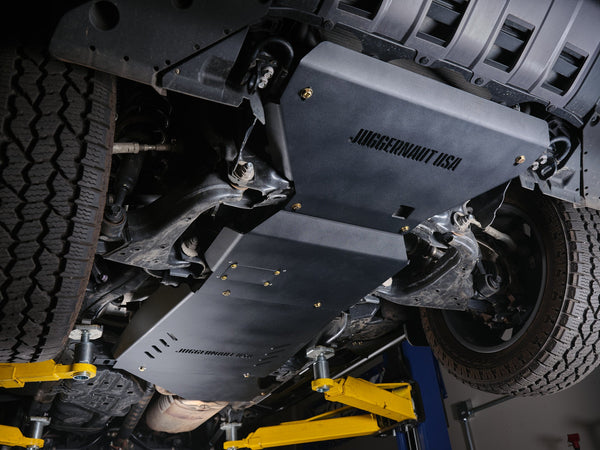
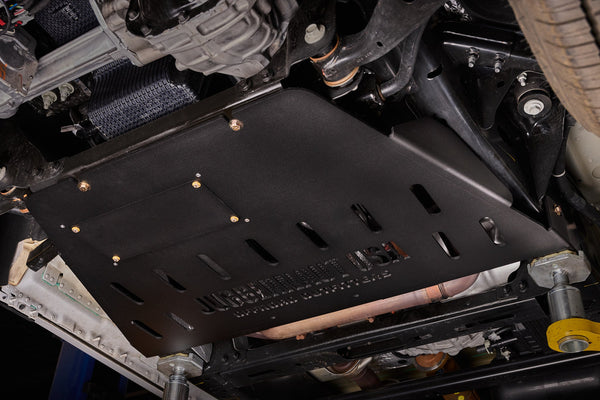
Second, and more practically: our Transit skid plate covers the catalytic converters — both versions, lip and no-lip — as part of the underbody plate, alongside the engine and intercooler. A plate over the converters raises the effort a thief has to put in, but it is armor, not a locking cage; if theft is your specific worry, our converter protection guide and the cat shield explainer are worth reading on what separates a shield from a cage.
What Ford gives you
Not much, and that is not really a criticism — the Transit is sold as a commercial vehicle, and commercial vehicles are specced for pavement, payload and service intervals rather than trail clearance.
Expect thin splash shielding: enough to keep road spray off components, not enough to stop anything solid. There is no factory skid plate package on this van in any configuration, including the AWD. Everything underneath is aftermarket territory.
Every real option on the market
The Transit aftermarket is more developed than most vans, which is good news if you want protection today. Honest rundown of who makes what, as of July 2026:
| Maker | Coverage | Material | Honest read |
|---|---|---|---|
| Van Compass | Intercooler, intercooler piping, oil pan; wraps up to shield the front bumper | 3/16″ 5052 aluminum, powder-coated | The only plate built specifically around the intercooler — the most commonly damaged component on this van. Bolt-on but requires minor drilling. Available for AWD. We are an authorized Van Compass installer and fit these regularly. |
| ASFIR 4x4 | Engine, gearbox | 1/4″ aluminum, laser cut | The thickest plate available and it reaches further back than most. Best choice if drivetrain impact protection is the priority. |
| Flatline Van Co | CORE front bumper skid, 2020+ | Aluminum | Front-bumper-focused rather than full underbody. Pairs with, rather than replaces, an engine plate. |
| Agile Off Road | Front skid | Aluminum | Well-established van outfitter; known quantity in the Transit and Sprinter world. |
| CAtuned Off-Road | 2021+ front skid | Aluminum | Newer entrant, 2021+ specific. |
| Transit Van Freaks | 2021+ front skid | 3/16″ aluminum | Van-specific outfit. |
| Northwest Overland | Front skid, 2014–2023 | Aluminum | Covers the earlier vans, which several makers skip. |
| Import / marketplace plates | Varies | Unspecified aluminum | Cheap, and the alloy and thickness are usually not stated. If a listing will not tell you the alloy, assume the worst. |
The thing nobody tells you: these plates don't cover the same components
Most fitment advice treats skid plates as interchangeable and argues about thickness. On a Transit that is the wrong argument, because the plates on the market protect different parts of the van, and none of them protect all of it.
- Van Compass is thinner (3/16″) but is the only one built around the intercooler and its piping, and it wraps upward to take a hit at the front bumper.
- ASFIR is thicker (1/4″) and reaches further back across engine and gearbox.
- Ours is 1/4″ and is built to cover the engine, intercooler, and catalytic converters together in a single plate.
So the honest recommendation depends on what you are actually worried about:
- Intercooler damage — the most common expensive hit on this van: Van Compass, or ours (it covers the intercooler too).
- Rocks and trail debris, drivetrain protection, reaches furthest back: ASFIR.
- Engine, intercooler, and converters in one 1/4″ plate: ours.
That gap used to be real: covering a Transit fully meant a front plate from one vendor and a converter solution from another, and still not in 1/4″ material throughout. Our Transit plate is built to close it — engine, intercooler, and catalytic converters in a single 1/4″ 5052-H32 plate.
3/16″ versus 1/4″ — why the number matters more than it looks
Most Transit plates are 3/16″ aluminum. A few are 1/4″. That sounds like a small difference and it is not.
Resistance to permanent bending scales with the square of thickness. Going from 3/16″ to 1/4″ is a 33% increase in material, but roughly a 78% increase in resistance to bending. That is the difference between a plate that takes a hit and a plate that takes a hit and stays flat.
It matters more on a van than on a truck, because a plate that deforms under load presses into the thing it was covering — and on a Transit the thing behind the plate is often an intercooler rather than a cast-iron oil pan.
That said, coverage beats material. A 3/16″ plate over the component you are actually going to hit is worth more than a 1/4″ plate over one you are not. Work out what you are protecting first, then compare thickness.
Two other things worth asking any maker:
- What alloy? "Aluminum" is not a spec. 5052-H32 is the marine-grade sheet worth asking for — it forms well, resists corrosion, and does not work-harden and crack the way some alloys do under vibration.
- Does it have service access? A plate you have to drop for every oil change is a plate you will eventually stop reinstalling.
The full engineering is in our aluminum vs steel breakdown.
Where we stand on the Transit
We make one. The Ford Transit Engine Skid Plate is a one-piece 1/4″ 5052-H32 aluminum plate that shields the engine, catalytic converters, and intercooler on 2015–2026 Transits, RWD and AWD. CNC plasma cut, press-brake formed, powder-coated, bolt-on to factory mounting points — cut in Wheat Ridge, Colorado, with a lifetime warranty. It comes with a front lip ($819.95) or without ($749.95), free shipping in the lower 48.

Ford Transit Engine Skid Plate
1/4″ 5052-H32 aluminum — engine, catalytic converters, and intercooler. 2015–2026, RWD & AWD. $749.95–$819.95.
Shop the Transit skid plate →We also run the shop: Transit suspension, wheels and tires, accessories and armor installs at our Wheat Ridge / Denver location — including fitting Van Compass and other brands' plates.
FAQ
Does the Ford Transit come with skid plates?
No. Factory underbody protection is thin splash shielding rather than structural armor, and there is no skid plate package on any configuration including the AWD.
What is most at risk under a Transit?
The intercooler — it sits low and forward, it is the first thing a rock finds, and it is not a roadside repair. Then the oil pan, transmission housing, oil and water lines, and the catalytic converters.
Which Transit skid plate should I buy?
It depends what you are protecting, because the plates cover different components. Van Compass is 3/16″ but is the only one built around the intercooler and its piping. ASFIR is 1/4″ and reaches further back across the drivetrain. Ours is 1/4″ and covers the engine, intercooler, and catalytic converters together. If the intercooler worries you, thickness is the wrong thing to optimize for.
Does a front skid plate protect the catalytic converters?
Ours does — both versions cover the catalytic converters along with the engine and intercooler, in one 1/4″ plate. It is armor rather than a locking cage, so for theft specifically it is still worth reading up on what a dedicated cat shield adds.
Does an AWD Transit need different plates than a RWD?
Yes. AWD adds a front differential and driveshaft, which changes both what needs covering and what fits around it. Confirm drivetrain and year before ordering from anyone.
Are Transit catalytic converters commonly stolen?
Yes, though the van is not quite as soft a target as its ride height suggests — owners report one of the two converters mounted close to vertical with limited tool access, which is a partial deterrent. Vans parked outside overnight in the same spot remain the highest-risk case.
Is 3/16″ aluminum thick enough?
It is real protection. Resistance to bending scales with the square of thickness, so 1/4″ resists permanent deformation roughly 78% better — but coverage beats material. A 3/16″ plate over the component you are going to hit is worth more than a 1/4″ plate over one you are not.
Do you make Ford Transit skid plates?
Yes. Our Ford Transit Engine Skid Plate covers the engine, catalytic converters, and intercooler in 1/4″ 5052-H32 aluminum, for 2015–2026 RWD and AWD vans, with a lifetime warranty.
Can you work on my Transit now?
Yes — suspension, wheels and tires, accessories and installs at our Wheat Ridge / Denver shop. We are an authorized Van Compass installer and fit other brands' armor as well.
Building a Transit
Tell us the year, the drivetrain and what you actually do with the van, and we will tell you what is worth protecting and what is not — including when the answer is somebody else's plate. Call or text (970) 341-4221 or email sales@juggernautusa.com.
Fitment varies by model year, wheelbase, and roof height. Always confirm your exact configuration before ordering — we check fitment free with every quote.
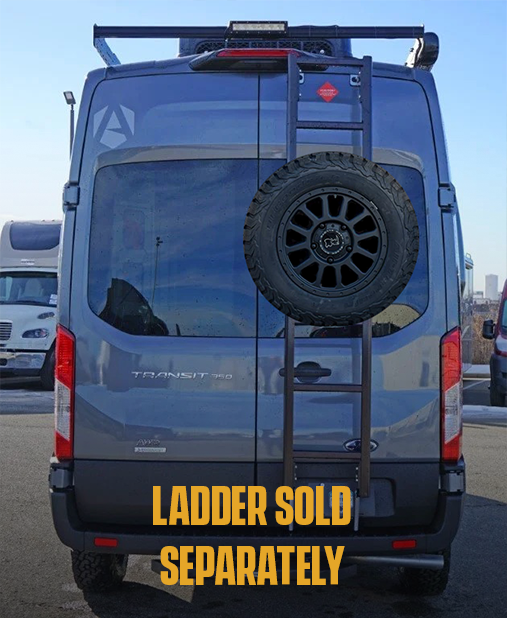
Transit engine skid plate and spare tire rack shipping now — and we install suspension, wheels, tires and racks at our Denver shop.