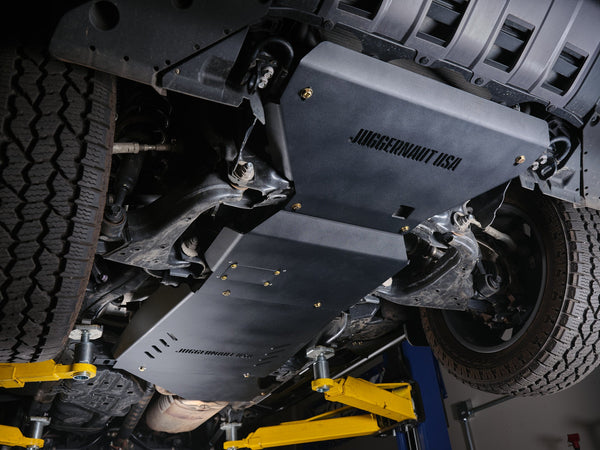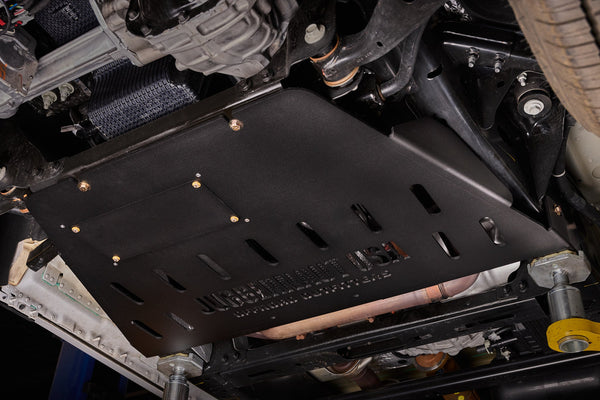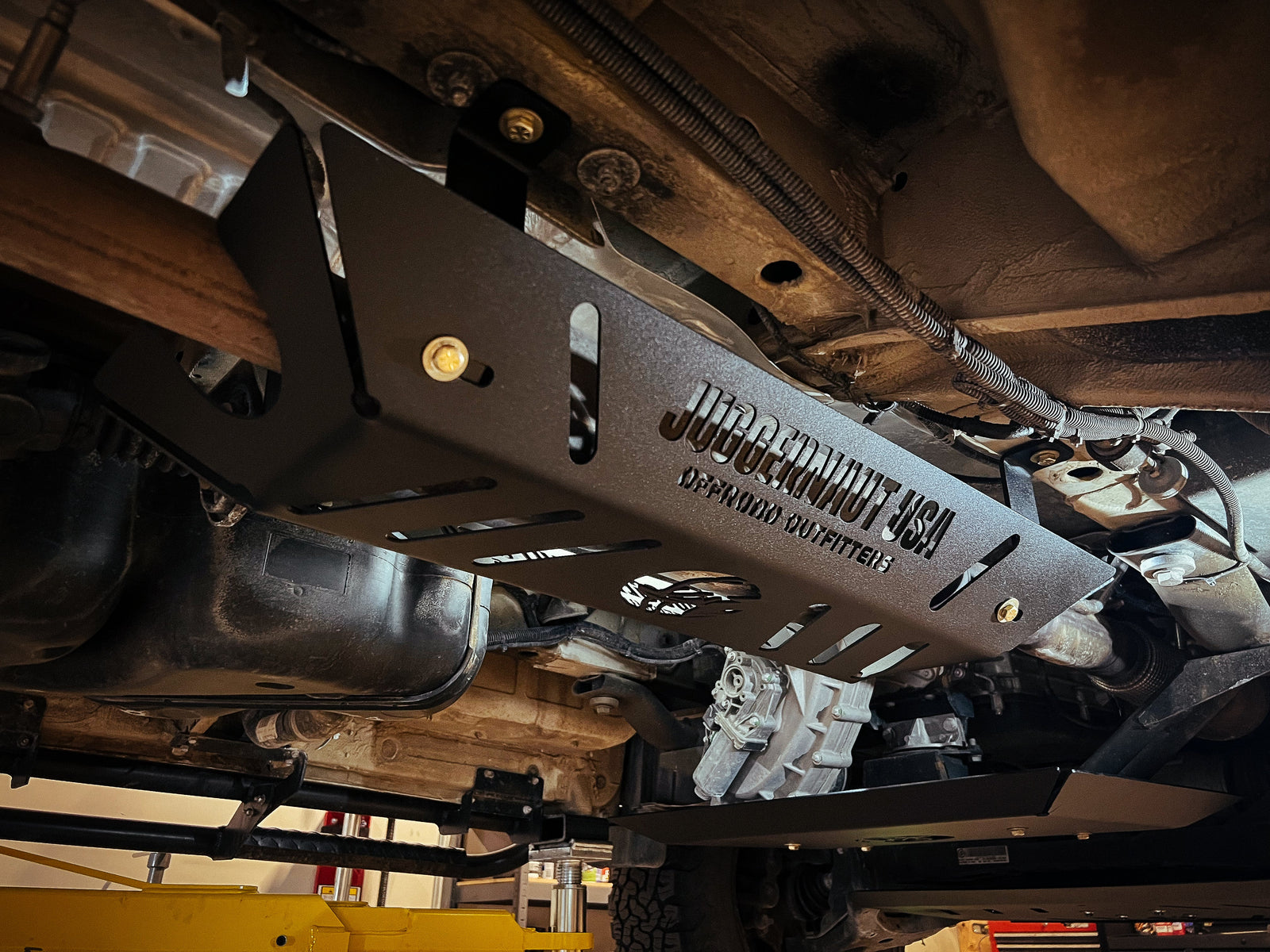
What Is a Cat Shield? Catalytic Converter Shields Explained.
A cat shield is a metal plate bolted over your catalytic converter to block a thief's saw. What the different names mean, whether they actually work, and how a shield differs from a cage or a lock.
Ask for the thickness first, in inches or gauge. A lot of what is sold as converter protection is sheet rather than plate, and stiffness scales with the square of thickness — so that gap is wider than the numbers look.
Then check coverage. The plate has to cover the pipe on both sides of the converter, not just the body of it, or the cut moves rather than stops.
Shield, guard, cover and protector all mean the same product. A cage is a different thing.
A cat shield is a metal plate bolted underneath a vehicle to cover the catalytic converter, so a thief cannot get a saw to it. It is the same idea as a skid plate, aimed at one component. Most are aluminum or steel, they bolt to existing points on the frame or exhaust hangers, and they work by denying access rather than by sounding an alarm or making the part traceable after it is gone.
The terminology is a mess — shield, guard, cover, protector, cage — and some of those words mean the same thing while others describe genuinely different products. This page sorts that out, explains how they work, and covers what to look for.
Jump to: What it is · Shield vs guard vs cage · Does it work · Material and thickness · Universal vs vehicle-specific · Shop by vehicle · FAQ
What a cat shield actually is
Your catalytic converter sits in the exhaust, underneath the vehicle, usually a few feet back from the engine. It contains small amounts of platinum, palladium and rhodium, which is why it gets stolen. With a battery-powered reciprocating saw a converter can be cut out in a couple of minutes.
A cat shield is a plate that sits between the thief and the converter. It bolts to the underbody — to the frame, a crossmember, or the exhaust hangers depending on the design — and covers the converter and usually the pipe on either side of it, because cutting the pipe is how the part comes out.

Two things follow from that. First, coverage matters more than the plate itself: a shield that leaves the pipe exposed on both ends does not stop the cut, it just moves it. Second, a shield is passive. It does not detect anything or alert anyone. It makes the job slow and loud enough that most people move to an easier vehicle.
Shield, guard, cover, protector, cage — what is the difference
Four of those five words describe the same product. One does not.
| Term | What it means |
|---|---|
| Cat shield | A solid plate bolted over the converter |
| Catalytic converter guard | Same thing. Manufacturers use the two interchangeably |
| Converter cover / protector | Also the same thing, usually in consumer-facing copy rather than spec sheets |
| Cat cage | Different. Steel bar or rebar welded or clamped into a lattice around the converter. It does not enclose the part — it makes cutting awkward and slow |
| Converter lock / cable kit | Different again. Steel cable or a lock threaded around the converter, usually the cheapest option |
The practical distinction is solid versus open. A plate physically blocks the blade. A cage or cable slows the cut but leaves the converter reachable — a thief with time and a grinder gets through. Cages are cheaper and can be fitted to almost anything, which is why shops that do not stock vehicle-specific plates often fit them.
If someone sells you a catalytic converter shield that turns out to be a bar cage, that is not necessarily a bad product, but it is not the same category and it should not be priced or compared as though it were.
Does a cat shield actually work
It is the most effective of the common options, with a caveat worth stating plainly: nothing makes a vehicle theft-proof. A determined thief with enough time gets through anything. What a shield does is change the economics of the attempt.
Converter theft is a volume crime. The reason it exploded was that a converter could be taken in under two minutes with a cordless tool. Anything that turns two minutes into fifteen, with more noise and more visible effort, moves the vehicle down the list. In a parking lot with other options, that is usually enough.
A shield is also the only common option that puts material where the blade needs to go. Cages and cables slow the cut without blocking it, alarms only help if somebody responds, and etching does nothing at all to the theft itself — it helps afterwards. If you are weighing those against each other rather than asking what a shield is, we take each one apart properly in cages, locks and alarms: what actually works.
Worth adding that the free measures are real. Lit parking, a garage where possible, and backing a tall vehicle against a wall so there is less room to get underneath all reduce the odds, and none of them cost anything.
Material and thickness
Here is the thing most buyers do not realize: cat shields are usually much thinner than skid plates. The word "plate" gets used loosely. A great deal of what is sold as converter protection is sheet metal — thin steel or thin aluminum, sometimes little more than a heavier version of the factory splash guard. It looks like armor in a product photo and folds around a blade.
That matters because of how bending actually works. Resistance to permanent deformation scales with the square of thickness — double the thickness and you get roughly four times the stiffness, not twice. Which means the gap between a genuinely thick plate and a typical thin shield is far wider than the numbers suggest at a glance.
It also explains why the steel-versus-aluminum argument is usually the wrong argument. Steel is the stronger material by volume, so a thin steel shield sounds reassuring — but a 1/4″ aluminum plate resists bending better than a much thinner steel one, at lower weight, and it does not rust where the coating chips. Steel's real advantage is surface hardness: it gouges less when dragged across rock, which matters more off-road than it does in a parking lot.
So ask for the thickness in inches or gauge before you ask anything else, and be suspicious when a listing will not say. "Heavy duty" is not a specification. The full material comparison covers the engineering.
On fasteners: look for hardware that cannot be backed out with a standard socket in a few seconds. A plate held on by four ordinary bolts is a slower theft, not a blocked one.
Universal versus vehicle-specific
Universal shields are sold as a flat plate plus clamps, fitted to whatever is underneath. They are cheap and they fit anything, which is the problem — exhaust routing varies enormously between vehicles, and a plate that is not shaped for the underbody either leaves gaps or hangs lower than it should and becomes the thing that catches on a curb.

A vehicle-specific plate is cut for one underbody. It uses factory mounting points, follows the existing geometry so it does not reduce ground clearance, and covers the pipe on both sides of the converter rather than just the body of it.
If you want to see what that actually involves rather than take our word for it, the install instructions are public — here are the Sprinter converter guard instructions and the ProMaster front plate instructions. Mounting points and service access are visible in both.
The trade is availability. Vehicle-specific plates only exist for platforms someone has bothered to engineer for — generally the ones that get stolen from most. If you drive something unusual, a universal shield or a cage may be the only real option.
Which vehicles need one most
Height is the main risk factor. A thief needs to get under the vehicle, and on a truck or a tall van they can do that without a jack — which is why full-size pickups and cargo vans dominate every most-targeted list. The Ford F-Series has been the most-targeted vehicle in the country, with the Econoline and Toyota Tacoma also in the national top ten.
Vans that park outside overnight are the highest-risk case of all: tall, unattended, and usually parked in the same spot every night.
Our catalytic converter protection guide goes vehicle by vehicle, and the shields we cut cover Ford, GM, Ram ProMaster, Sprinter and Nissan NV.
Shop cat shields by vehicle
These are the vehicle-specific plates we cut and powder coat in Colorado — each uses factory mounting points and covers the pipe on both sides of the converter. Do not see yours? The full catalytic converter protection collection has the current lineup.
- Ram ProMaster front skid plate — engine, transmission and converter in one plate
- Ford Super Duty engine & trans skid plate — F-250 through F-550
- Mercedes Sprinter catalytic converter guard
- Ford F-150 transmission skid plate & cat shield
- Ford Expedition transmission skid plate & cat shield
- Ford Ranger transmission & converter skid plate
- Chevy Silverado 1500 and GMC Sierra 1500 transmission skid plates
- Nissan NV1500/NV2500/NV3500 skid plate
FAQ
What is a cat shield?
A metal plate bolted under a vehicle to cover the catalytic converter and block access to it. It prevents theft by making the converter hard to cut out, rather than by alerting anyone.
Is a cat shield the same as a catalytic converter guard?
Yes. Shield, guard, cover and protector all describe the same product. A cage is different — that is an open steel lattice rather than a solid plate.
Do cat shields actually stop theft?
They are the most effective common option, but nothing is theft-proof. A shield turns a two-minute job into a slow, loud one, and most thieves move to an easier target rather than finish it.
How thick should a cat shield be?
Thicker than most of them are. A lot of converter protection is sheet rather than plate, and because stiffness scales with the square of thickness, the gap between a thin shield and a real plate is much wider than the numbers look. Ask for a figure in inches or gauge, and treat "heavy duty" as marketing.
Will a cat shield affect my ground clearance?
A vehicle-specific plate should not — it is shaped to sit within the existing underbody geometry. A universal plate clamped on can hang lower than what it covers, which is one reason to prefer a plate cut for your vehicle.
Does a cat shield make service harder?
A well-designed one has service and drain cutouts so routine work does not require dropping the plate. Ask before buying — not all of them do.
Aluminum or steel?
Both work as a barrier, and it is usually the wrong question. Thickness matters far more than material: a 1/4″ aluminum plate out-resists a much thinner steel shield at lower weight and will not rust. Steel gouges less under repeated abrasion, which matters off-road more than in a car park.
Can I install one myself?
Most bolt-on plates are a driveway job with a jack, stands and hand tools. Plates that require drilling or welding are a different proposition. What's actually involved in the install covers where it goes wrong and when to hand it to a shop.
Does insurance cover converter theft?
Comprehensive coverage generally does, subject to your deductible. Many thefts never become claims, which is part of why reported figures understate the real number.
Fitment varies by model year, wheelbase, and roof height. Always confirm your exact configuration before ordering — we check fitment free with every quote.
Bolt-on 1/4-inch aluminum cat shields that cover the converter. Find the one that fits your vehicle.