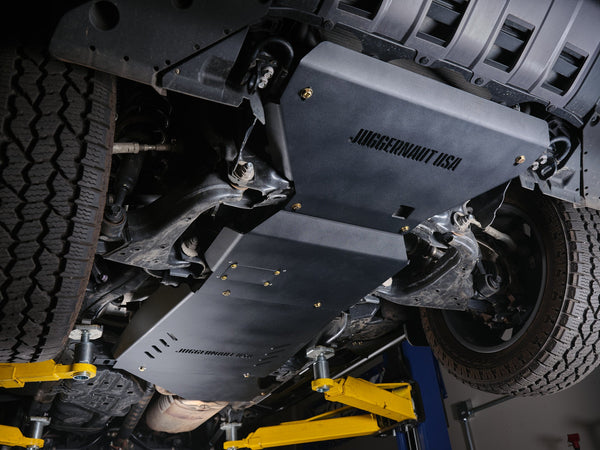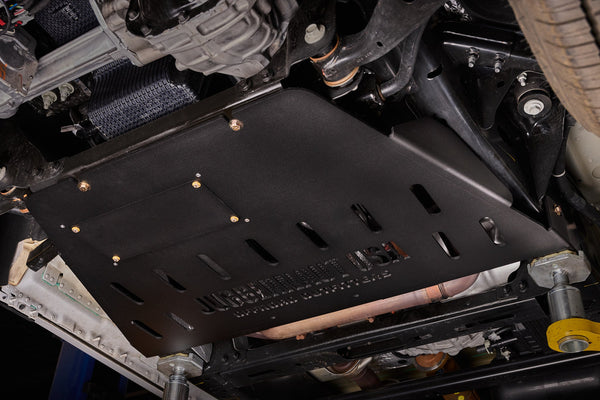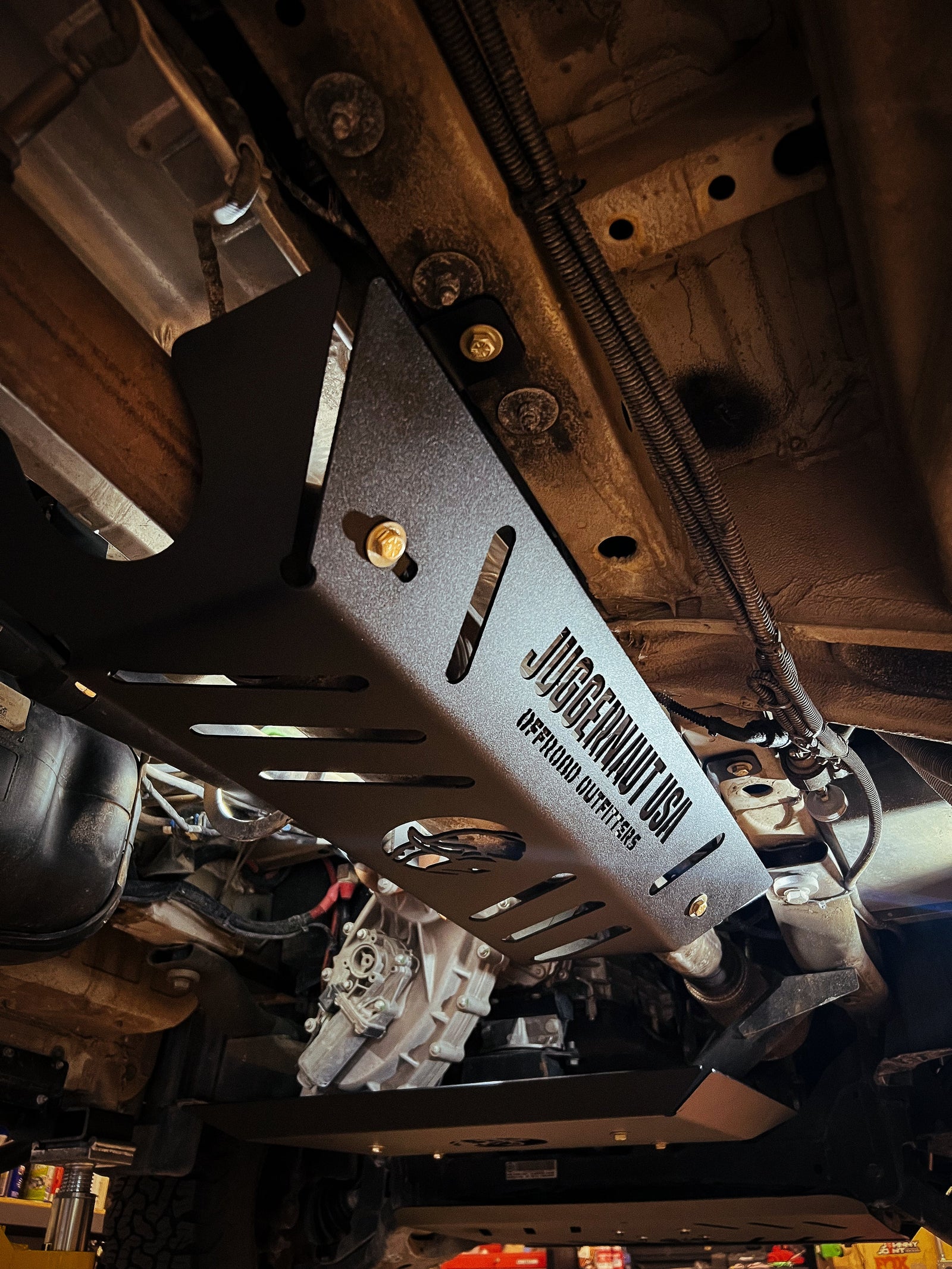
Cat Shield Installation: What's Actually Involved.
A bolt-on converter shield is usually a driveway job with hand tools. What the install actually looks like, where it goes wrong, and when it is worth handing to a shop.
A floor jack, a socket set and a torque wrench. Two things decide how involved the job is.
If the vehicle has run salted roads, apply penetrating oil the night before — seized hardware is the usual delay. And use the jack with a block of wood to hold the plate while you start fasteners rather than holding it up by hand.
Start every fastener by hand, torque in a staggered pattern, and check nothing contacts the exhaust. Hand it to a shop if the underbody is badly corroded.
Most bolt-on catalytic converter shields are a driveway job: jack, stands, hand tools. The exceptions are worth knowing about before you are already under the vehicle with a socket that will not break a bolt loose.
This page covers what the install actually involves, the two things that reliably turn a simple job into a long one, and when it is worth handing over.
Jump to: What you need · What the job looks like · Where it goes wrong · When to use a shop · After it is on · FAQ
What you need
- A way to get under the vehicle safely. On a truck or a van you can often work without lifting at all, which is convenient and is also exactly why these vehicles get targeted. If you do lift it, use stands. Never work under a vehicle held up by a jack alone.
- Basic hand tools. Socket set, ratchet, extensions, a torque wrench. Nothing specialist.
- Penetrating oil, applied the night before if the vehicle has seen winters on salted roads. This is the single highest-return step in the whole job.
- A light and eye protection. You are working overhead; everything you loosen falls toward your face.
What you should not need: drilling, cutting, or welding. A plate designed for your vehicle uses existing mounting points — every shield we cut bolts on that way. If the instructions call for drilling into the frame, that is worth a second look at what you have bought.

What the job looks like
Broadly the same across vehicles:
- Locate the mounting points. Usually existing holes or captured nuts in the frame rails, a crossmember, or the transmission bellhousing area. Clean any road grime out of the threads before you start.
- Test-fit the plate before committing. Offer it up, get one or two fasteners started by hand, and confirm everything lines up before running anything down. On a heavy plate a second pair of hands or a jack under the plate makes this far easier than doing it single-handed.
- Start every fastener by hand. Cross-threading a captured nut in the frame is the one mistake in this job that turns a simple install into a bad week.
- Torque in a staggered pattern, not one corner at a time — same principle as a wheel. Snug everything, then torque to spec.
- Check clearance. Nothing should touch the exhaust or a driveshaft. Exhaust components move and grow with heat, so a gap that looks tight when cold is a rattle or a burn mark later.
If you would rather see the specifics for a particular plate, our install instructions are public — the Sprinter converter guard and ProMaster front plate instructions both show mounting points and hardware.
Where it goes wrong
Seized hardware. This is the main one, and it is entirely a function of where the vehicle has lived. A truck that has run salted roads for a decade has fasteners that have been in place, wet, for years. Penetrating oil the night before, heat if you have it, and patience. Rounding a bolt head at this point is how a simple bolt-on becomes a drill-and-extract job.
Doing it alone with a heavy plate. A 1/4″ aluminum plate is manageable but awkward overhead, and holding it in position while starting fasteners is genuinely harder than it sounds. A floor jack with a block of wood, or a second person while you start the first bolts, removes the whole problem.
Assuming fitment. Confirm the model year and, where relevant, the trim and drivetrain before you are underneath. Generation changes are where this catches people — a plate for a 2015-and-newer truck will not fit a 2014 one, and off-road trims can differ underneath.
Skipping the torque spec. Overtightening into aluminum or a captured nut strips it; undertightening lets the plate work loose over washboard and rattle.
When it is worth using a shop
Handing it over makes sense when:
- The vehicle is a salt-belt truck with a decade of corrosion on the underbody hardware. A shop with a lift, air tools and heat handles seized hardware far more easily than you can on your back.
- It is going on with other work. If the vehicle is already up for a service, a lift, tires or exhaust work, adding the plate costs very little extra labor. This is the efficient way to buy it.
- It is a van with a conversion in it. Access is the issue, not difficulty.
- You do not have a safe way to get under it. Not a failure — it is the correct reason to pay someone.
We fit these at our shop in Wheat Ridge, and if you are already booked in for something else it is worth adding to the same visit.
After it is on
Re-check the fasteners after the first hundred miles or so, and again after the first proper off-road trip. New hardware settles, and this is a quick check.
Know where your service cutouts are. A well-designed plate has drain and service access so an oil change does not require dropping it. Point them out to whoever services the vehicle, because a shop that does not know they exist will drop the plate anyway — and the plate that gets dropped every service is the one that eventually does not go back on.
Expect nothing to change in how it drives. A plate cut for the vehicle sits within the existing geometry. If you are hearing a new rattle or scraping something you did not before, something is not right — go back and check clearance.
Related guides: What is a cat shield? · Cages, locks and alarms compared · Catalytic converter theft protection
FAQ
How hard is a cat shield to install?
On clean mounting points it is a driveway job with hand tools. Corroded hardware on an older salt-belt vehicle is the main thing that makes it harder, sometimes considerably.
Do I need to drill anything?
No. A plate designed for your vehicle uses existing mounting points. Instructions calling for drilling into the frame are a reason to question what you bought.
Do I need to lift the vehicle?
On a truck or van you can often work without lifting. If you do lift, use stands — never work under a vehicle supported only by a jack.
Will it need to come off for servicing?
It should not, if it has proper drain and service cutouts. Tell whoever services the vehicle where they are. If you are still choosing a plate, what to look for in a cat shield covers why that matters.
Can one person do it?
Yes, but a floor jack under the plate to hold it in position while you start fasteners makes it far easier than wrestling it overhead single-handed.
What torque should I use?
Follow the spec supplied with the plate. Overtightening strips captured nuts; undertightening lets the plate work loose on rough roads.
Does installing one affect my warranty?
Bolt-on protection using existing mounting points, with no modification to the exhaust or emissions hardware, generally does not. Welded cages are a different conversation because they attach to emissions components — see cages, locks and alarms.
Where can I get a plate for my vehicle?
We cut converter shields for Ford, Chevrolet and GMC trucks, Ram ProMaster, Mercedes Sprinter and Nissan NV — all 1/4″ aluminum, bolt-on, backed by our Limited Lifetime Manufacturer's Warranty. If yours is not on that list, a cage may be your only vehicle-agnostic option.
Fitment varies by model year, wheelbase, and roof height. Always confirm your exact configuration before ordering — we check fitment free with every quote.
Shop the shield that fits your vehicle, or have our Wheat Ridge shop bolt it on for you.