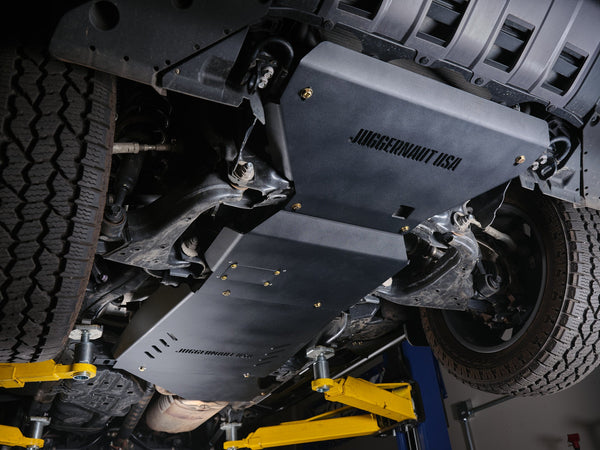
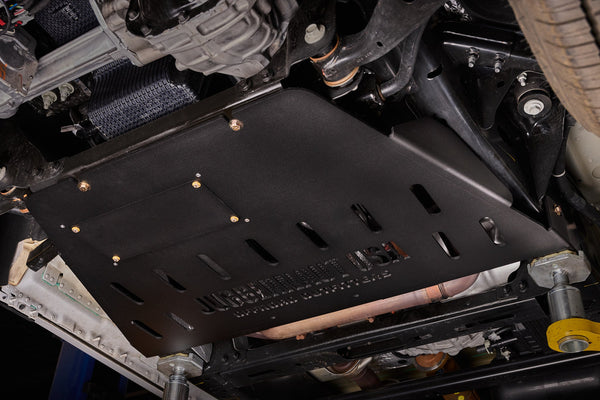
Skid Plate
2020-2026 Ford Super Duty Engine & Trans Skid Plate
Lifetime Warranty
True Bolt-On Fit
4.89
(18)

37s fit a 2017+ Super Duty — but the wheel decides how much you cut, not the lift. Offset by offset, what clears and what you trim, plus the 2023 radius-arm change and the one part 2017-2022 trucks need that nobody mentions.
How much you cut depends more on wheel offset than on lift height.
At 0 to +12mm offset on an 8.5 to 9.5 inch wheel, you are down to minor fender-liner trimming. Go further negative and you are into pinch-weld work.
A leveling kit can get you there; a true lift gives you margin. Budget for the alignment, and on a diesel consider a regear.
Lift is not what gets 37s under a Super Duty. The wheel is.
It is the most common misunderstanding on this truck, and it costs people money. Height helps at rest, but the moment the suspension compresses you are back at stock clearance — and the tire is still trying to occupy the same space as the radius arm. What actually decides whether a 37 fits, and how much you cut to make it fit, is offset, width and backspacing.
This guide is organized that way: find your wheel, read what it costs you. Covers the 2017-and-newer F-250 and F-350, with a section on duallies at the end.
Last verified July 2026.
Fitting 37s near Denver? We mock up wheel-and-tire combinations and install leveling kits, radius arms and sway bars. See Super Duty lift and leveling installs, or call or text (970) 341-4221.
Jump to: Why the wheel decides · The 2023 chassis change · Offset by offset · Do you need a leveling kit? · The part 2017–2022 trucks need · On stock wheels · What trimming means · Tires that work · Duallies · Alignment, regear, armor · FAQ
Factory Super Duty wheels sit at roughly +40 to +45mm offset on an 8″ wheel, with 5.5″ to 6.5″ of backspacing on a 8×170mm bolt pattern. That is a deeply tucked wheel — Ford builds in a lot of inboard room.
Tucked inboard is exactly the problem. On a solid-axle truck the tire's inner shoulder swings back toward the radius arm and sway bar at full steering lock. The further inboard the wheel sits, the sooner it gets there. A taller lift does not help, because the parts stopping you are inboard, not above — and the moment the suspension compresses you are back at stock clearance anyway.
Move the wheel outboard and the tire swings clear of the suspension instead of into it. Going from +45mm to +6mm pushes the tire out roughly an inch and a half. That is the whole mechanism.
Ford ran essentially the same front radius arm design from 2005 through 2022. For the 2023 Super Duty they redesigned the radius arms, the frame-side bracket and the sway bar, and the result was a large gain in tire clearance.
They changed the exact parts that limit tire fitment on this truck. Worth being precise about what that does and does not solve, because they are two different limits:
| 2017–2022 | 2023+ | |
|---|---|---|
| Radius arms & sway bar | 2005-era design, tucked tight | Redesigned, far more clearance |
| Stock wheels, stock height | 285–295 metric | Considerably more |
| 35s on stock wheels | Workable | Clears without issue |
| 37×12.5 on stock wheels | Radius-arm rub at full lock + liner trim | No arm or sway-bar contact; liner trim at stock height |
| 37×13.5 at +12 to +18 offset | Requires aftermarket radius arms + sway bar | Clears on factory arms |
If you are shopping used and big tires are the plan, a 2023+ truck starts you meaningfully further ahead — far enough that it can be worth factoring into which truck you buy.
Find the wheel. Everything else follows from it.
| Offset | Width / backspacing | Stance | 37s on 2017–2022 | 37s on 2023+ |
|---|---|---|---|---|
|
+40 to +45mm factory |
8″ / 5.5–6.5″ | Deeply tucked | Radius-arm rub at full lock + liner trim | 12.5 or 11.5 all-terrain, no arm contact; liner trim at stock height |
| +12 to +18mm | 8–9″ | Flush with the flares | 37×12.5 with minor liner trim. 37×13.5 needs aftermarket radius arms + sway bar |
37×12.5 and 37×13.5 on factory arms |
|
+1 to +12mm ← the sweet spot |
8.5–9.5″ | About 1″ proud of the fender | 37×12.5 and 37×13.5, minor trimming only. Best balance of look and clearance on either chassis. | |
| 0mm | 8–9″ / 4.75–5″ | Slight poke | 37×12.5 and 37×13.5 clear. Trimming scales with tire width. | |
| −12mm | 8–9″ / 4.5″ | Noticeable poke | 37×12.5 with moderate liner trimming plus pinch-weld work. A 13.5 is possible with more cutting. | |
| −24mm and beyond | 10″+ | Wide | Not a 37 setup. 33s clean, 35s with moderate trimming. 37s only if you accept heavy trimming and lost turning radius. | |
If you take one thing from this page: target +1 to +12mm on an 8.5–9.5″ wheel. It clears a 37 in either common width with the least cutting of anything here, on either chassis.
Wheel diameter has no effect on fitment. It affects ride — more sidewall and less wheel rides better, so a 17″ or 18″ under a 37 is more comfortable than a 20″ or 22″.
Everyone asks this, and the useful answer starts by separating two things a leveling kit is assumed to do — only one of which it actually does.
A level does not create the clearance that limits you. The limiting factor is the radius arm and sway bar at full steering lock, and those sit inboard. Raising the truck does not move the tire away from them, and at full compression you are back at stock clearance regardless.
What a level does buy is stance. Static clearance at rest, the factory rake gone, and a front end that looks right under a tire that tall. That is a real reason to fit one — it is just not a clearance reason.
The fitment data itself is the proof: the guidance for a leveling kit and for a 4–6″ lift is identical. Same offsets, same tires, same trimming. If height were the variable, those would differ.
Assume you need a leveling kit. A 37 on a pre-2023 truck at genuine factory height is not a setup we would spec — at stock height these are realistically a 35 truck on stock wheels.
The order of what actually gets you to 37s on one of these:
Ford's redesign changed what clears. It did not change what a leveling kit does — the level still buys stance and still does not solve radius-arm contact, because that was never what it solved.
What changed is that on a 2023+ you are far less likely to need anything beyond the right wheel and some trimming to make a 37 physically work. So the question narrows to appearance: at true factory height a 37 sits high into the fender on a base truck, and most people who level a 2023+ are doing it for that, not for clearance.
Worth being straight about the evidence here — the 2023+ trucks we see running 37s with no leveling kit at all tend to be Tremors, which start taller from the factory. That is a meaningfully different starting point from a base XL, so do not read "2023+ doesn't need a level" as a blanket rule.
Tremor and snow-plow-prep trucks sit taller from the factory — effectively pre-leveled. If you have one, "no leveling kit" means something different than it does on a base truck, because Ford already gave you the stance a level would buy.
It does not change what physically clears — the radius arm is still where it is — but it does mean a Tremor owner can reasonably skip the level and have a truck that looks right on 37s. On a base XL or XLT at true factory height, the same tire sits into the fender in a way most people do not want to live with.
This is the most expensive thing to find out late.
On a 2017–2022 truck running a 37×13.5 on a +12 to +18mm offset wheel, aftermarket radius arms and a high-clearance sway bar are mandatory — not an upgrade, a requirement — to keep full turning radius without rubbing. Carli is the usual answer and it is what we fit.
The same parts also rescue a factory-offset truck running 37×12.5, where the stock arms and sway bar are exactly what you are hitting.
On 2023+ trucks you do not need them for that fitment. The redesigned arms already provide the clearance. That single difference is worth several thousand dollars between the two chassis, and it is the clearest reason the 2023 change matters.
People do band-aid this with wheel spacers instead. It works in the sense that it pushes the tire outboard, but you are correcting a wheel-spec problem with an adapter. We would rather spec the wheel right the first time.
| Level | What gets cut | Typical case |
|---|---|---|
| Minor | The edge of the black plastic fender cap | Standard 37×12.5 at a good offset |
| Moderate | Fender cap plus the plastic inner fender liner | 37×13.5, or 12.5s at negative offset |
| Heavy | Cap, liner, pinch weld, and a liner pull-back — drilling the pinch weld and tying the liner away from the tire | Wide tires at aggressive offset, or going past 37s |
None of this cuts the fender or anything visible from outside the wheel well — it is all inside. And start small: you can always remove more material, never put it back.
Two tires marked 37×12.50 do not fit the same. Aggressive mud-terrains carry more shoulder further out, so they contact the radius arm at full lock sooner than a rounder all-terrain of identical nominal size. On a marginal fitment that decides it — which is why the 2023+ stock-wheel answer specifies all-terrain.
On an 8.5–9″ wheel at +12 to +18 or 0 offset, these clear with no or very minimal trimming in 12.5 width:
Step up to 13.5 width, or to a full mud-terrain in 12.5, and you move into mild-to-moderate liner trimming. On 2017–2022 trucks a 13.5 at this offset is where the radius-arm and sway-bar requirement kicks in.
Everything above assumes a single-rear-wheel truck. On an F-350 DRW or F-450, almost none of it transfers.
The rear becomes the constraint, not the front. On a single-rear-wheel truck the limiting factor is the radius arm at full steering lock — a front-end problem, solved with offset. On a dually the front behaves broadly like an SRW truck, but the rear introduces two limits that do not exist on a single-wheel truck:
The offsets are in a different universe as a result. Where an SRW Super Duty runs +40 to +45mm, F-450 dual-rear-wheel setups run in the region of +110 to +130mm with roughly 6.5″ to 7″ of backspacing. That is not a variation on the SRW numbers — it is a separate spec, and SRW offset advice applied to a dually is actively wrong.
Being straight about what we know: published dually-specific data for 37s is much thinner than SRW data — most fitment guides, ours included, are written around single-rear-wheel trucks. If you are running a dually and want 37s, this is a case where measuring your specific truck beats any chart. We are happy to do that.
An alignment, every time. Any ride-height change moves the front-end geometry. On a solid-axle Super Duty the number that matters most is caster — lifting rotates the axle and pulls caster out, and low caster is the most common trigger for the front-end shimmy these trucks are known for. Toe alone is not enough. Ask about caster correction when you book a Super Duty lift or level.
The regear conversation, on the diesels. A 37×12.50 is a full two inches taller than the 35 it replaces, which raises effective gearing enough to feel — especially loaded or towing. Not mandatory, but budget for it as a real possibility rather than a surprise.
Rock chips. Mud flaps are the traditional answer and they mostly stop fitting once you are playing for millimeters of tire clearance. Paint protection film on the rockers and lower panels is the practical substitute.
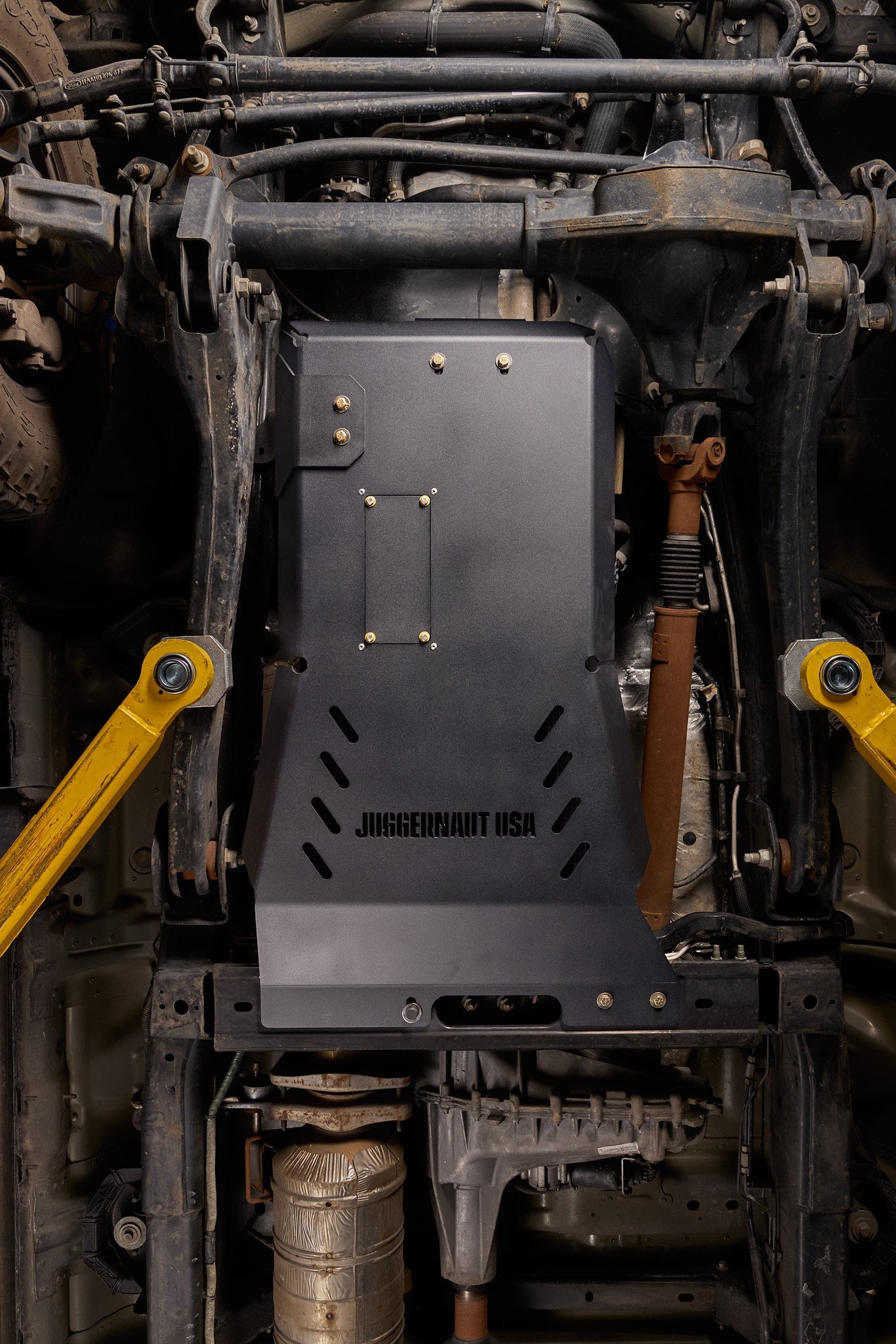
What you just exposed. Bigger tires and more lift put the truck into terrain it could not reach before, and the oil pan, transmission and transfer case are working harder for it. That is the one part of this we build ourselves — 1/4″ 5052-H32 aluminum, cut in Wheat Ridge. See our Super Duty skid plates and the Super Duty skid plate guide.
Related guides: Super Duty skid plate guide · Best F-150 lift kits · Fitting 35s on a Tacoma
Do I need a leveling kit for 37s?
On a 2017–2022, plan on it — at true factory height those are realistically a 35 truck on stock wheels. On a 2023+ you are less likely to need one to make the tire physically work, but at factory height a 37 still sits high into the fender on a base truck, so most people level it for looks. Either way, understand the level is buying stance rather than solving the radius-arm contact that actually limits you — the wheel offset does that.
What wheel offset do I need for 37s on a Super Duty?
+1 to +12mm on an 8.5–9.5″ wide wheel. It clears both a 37×12.5 and a 37×13.5 with minor trimming on either chassis, and sits about an inch proud of the fender.
Do 37s fit on stock Super Duty wheels?
On a 2023+, yes — a 37×12.5 or 11.5 all-terrain clears the factory +40 offset wheels without hitting the radius arms or sway bar, though you will want fender-liner trimming at stock height. On a 2017–2022 it is the hard way: radius-arm rubbing at full lock plus trimming, and aftermarket arms may still leave contact.
Do I need radius arms for 37s?
On a 2017–2022 running a 37×13.5 at +12 to +18 offset, yes — aftermarket radius arms and a high-clearance sway bar are required to keep full turning radius. On a 2023+ you do not.
Does the Tremor package change anything?
It sits taller from the factory, so it is effectively pre-leveled — a Tremor owner can reasonably skip a leveling kit and still have the truck look right on 37s. It does not change what physically clears, since the radius arm is still where it is.
Does any of this apply to a dually?
The front, broadly. The rear, no. Dually rear offsets run around +110 to +130mm versus +40 to +45mm on a single-rear-wheel truck, and the limiting dimension is the gap between the inner and outer tire rather than the radius arm. Spec a dually on its own numbers.
Does tire brand matter or just the size?
It matters. A mud-terrain with square side lugs contacts the radius arm sooner than a rounder all-terrain of the same nominal size. On a marginal fitment it is the deciding factor.
Will I have to cut my fenders?
No. Trimming here is inside the wheel well — the plastic fender cap, the liner, and on aggressive setups the pinch weld. Nothing visible from outside gets cut.
Do bigger wheels help fit bigger tires?
No. Wheel diameter has no effect on fitment. It affects ride — more sidewall and less wheel rides better, so a 17″ or 18″ under a 37 is more comfortable than a 22″.
What about wheel spacers instead of new wheels?
They push the tire outboard and can make a marginal fitment work, but you are correcting a wheel-spec problem with an adapter. Buying the right offset the first time is cleaner.
Bring us the truck and the wheel-and-tire combination you are considering. We will mount it, sweep the steering lock to lock, cycle the suspension, and show you exactly where it touches — before you have paid for a set of wheels that needs a radius-arm kit to work. An afternoon on the hoist is cheaper than the wrong wheels.
Call or text (970) 341-4221, email sales@juggernautusa.com, or stop by 4840 Van Gordon St Unit #300, Wheat Ridge, CO. More on our Super Duty work: Super Duty lift and leveling installs.
Shop your plates below, or email sales@juggernautusa.com with your year and trim and we’ll spec it.


Protects engine, transmission, transmission cooler and transfer case. One part number, one box, one install afternoon.
Free shipping, lower 48 · guaranteed fit or we cover return shipping · cut, welded and coated in Wheat Ridge, CO
We install these at our Wheat Ridge shop with a lifetime labor warranty — see Super Duty lift kit installation.
Shop tip: Offset matters more than lift height. Two trucks at the same lift can clear completely differently on 37s depending on wheel offset and width — a more negative offset pushes the tire out into the fender and forces more trimming. Pick the wheel and the tire together, not separately.
We build these end-to-end — lift or level, wheels, tires and trimming, with the alignment arranged — and we'll test-fit and spec your exact setup so it clears the first time. Call or text (970) 341-4221, email sales@juggernautusa.com, or stop by 4840 Van Gordon St Unit #300, Wheat Ridge CO.