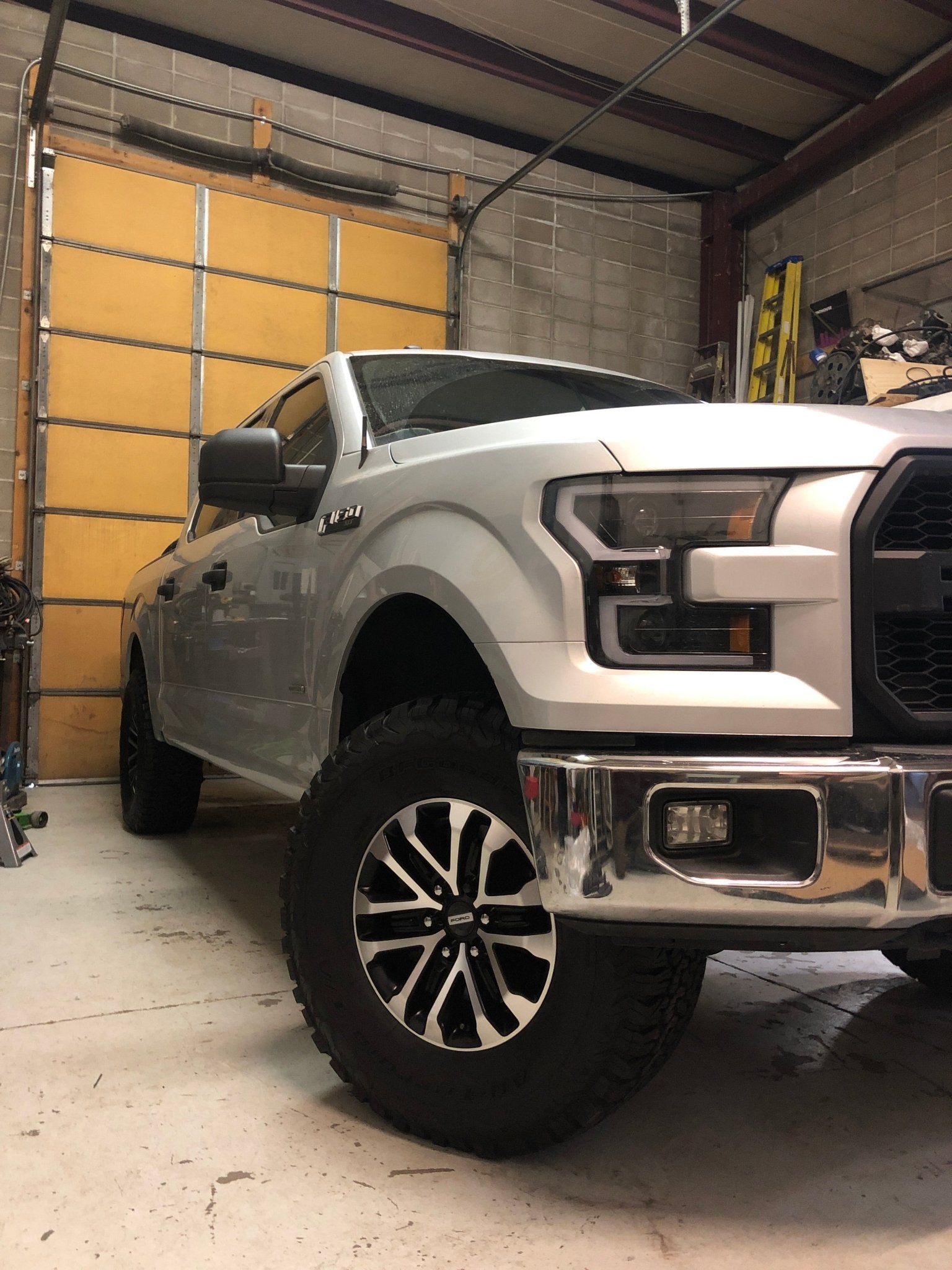
Shop floor · Wheat Ridge, CO
Best Ford F-150 Lift Kit Options: By Budget & Performance.
An honest, vendor-neutral lift kit guide for the 2021+ F-150 — we install every brand here and make no kit of our own, so the rankings are straight. Three tiers by budget and use, the supporting parts people forget (UCAs, alignment, regear), and the PowerBoost and CCD caveats that catch buyers out.
The short version
Three tiers by budget and use, and we install every brand covered here.
The costs that usually get missed: upper control arms, the alignment, and a regear once the tires get big.
Two caveats specific to this truck — the PowerBoost hybrid and the CCD electronically adjusted suspension, which most conventional kits are not built to work with.
~2.5"
Where IFS angles start needing UCAs
3 tiers
Budget · Mid · Performance
$0
Lift kits we make — we install all brands
35s+
Tire size that often triggers a regear
We install lift kits and suspension on 2021+ Ford F-150s every week — from every major brand — but we don't make or sell our own lift kit. That's exactly why this guide can be straight with you: we have no kit to push, so we can rank the real options honestly by budget and by how you actually use the truck.
This covers the 14th-generation F-150 (2021 and newer, independent front suspension). Four tiers, real brands only, and the supporting parts most people forget to budget for. We deliberately don't print dollar figures — suspension pricing moves constantly and a number that was right the day this was written would quietly go stale. Fitment depends on your exact engine, cab, drivetrain and options, so always confirm a kit fits your specific truck.
Jump to: How to think about it · The factory option · Budget / Leveling · Mid-tier (2–6″) · Premium coilovers · Mid-travel & long-travel · PowerBoost & CCD · Comparison · How to choose · FAQ
How to think about an F-150 lift before you spend a dollar
Three concepts decide almost everything. Get these right and the brand choice gets easy.
Leveling vs. lift vs. long-travel. A leveling kit raises the front roughly 1.5–2.5″ to remove the factory rake so the truck sits flat and clears slightly bigger tires (33s, sometimes 34s). A suspension lift (typically 4–6″+) raises the whole truck, clears 35s and up, and changes ride height enough that you need geometry-correcting parts. Mid-travel and long-travel systems aren't about height at all — they replace control arms to add wheel travel, and they are a different category of build.
Budget vs. ride quality vs. capability — pick two honestly. The cheapest path (a spacer) gets you height and does nothing for ride. The plushest ride comes from a quality coilover, which costs more than the height alone justifies. The most capability costs the most and demands the most supporting parts.
The supporting costs people forget. The kit price is rarely the out-the-door number. On an IFS F-150, plan for several of these:
Upper control arms (UCAs). Past roughly 2.5–3″ of front lift, the factory upper arms run out of geometry — ball-joint and control-arm angles get steep and you can't always dial alignment back into spec. The major UCA makers market corrected arms for the 2–3.5″ range specifically, which tells you where the industry draws the line. Many quality 3″+ kits include them; cheaper spacer kits do not.
CV axle and ball-joint angles. The IFS front end has a real ceiling. Lifting steepens the half-shaft and ball-joint angles, and past roughly 3″ on stock geometry is where owners and shops report accelerated CV boot and ball-joint wear. Treat that as a working rule of thumb rather than a published spec — Ford doesn't publish a maximum. This is the single biggest reason "more lift" isn't automatically "more better" on this truck.
Alignment — always. Every height change needs one afterward. Not optional.
Driveline and regear. Bigger tires change your effective gear ratio, which makes the truck feel sluggish and hurts economy. A regear restores it — commonly recommended at 35s, strongly recommended at 37s, and typically the largest single supporting cost after the kit.
Install labor. Scales with complexity. A spacer level is a short job; a tall kit with UCAs and a regear is a multi-stage build. We quote your specific combination up front — see our F-150 lift kit installation page.
Start here: Ford makes one too
Worth knowing before you shop aftermarket, because almost no guide mentions it — Ford Performance sells its own Off-Road Suspension kit for the 2021+ F-150, through Ford Performance Parts and dealers.
The case for it is narrow but real: it is engineered by Ford for the platform, and being a Ford Performance part it sits in a much friendlier position with your factory warranty than an aftermarket kit does. If warranty peace of mind is worth more to you than tuning range or height, start your shopping there rather than treating aftermarket as the only option.
The case against is that you are buying Ford's single answer rather than choosing a damper for how you actually drive, and it will not take you where a 6″ kit or a coilover system will. For a lot of leased or under-warranty trucks that is a fair trade.
Tier 1 — Budget / Leveling (level the rake, clear ~33–34s)
Real brands & kits: Rough Country (2″ leveling kit), ReadyLIFT billet leveling kits, and Bilstein 5100 adjustable struts. Spacer and strut-extension kits are the entry point; the 5100 is a step up in ride for not much more.
Who it's for: the daily driver who wants the nose level, a slightly more aggressive stance, and room for 33s without changing how the truck drives or what it costs to maintain. This is the right answer for most F-150 owners, full stop.
What you give up: a pure spacer raises the truck without improving the damper, so ride quality stays stock — the 5100 route fixes that for a little more. You're capped at modest tire sizes and won't transform off-road performance.
What it needs: an alignment, and a recheck of CV and ball-joint angle if you go to the top of the range. Usually no UCAs and no regear at this height. See our F-150 leveling kit installation page.
Tier 2 — Mid-tier (the coilover level and the 4–6″ lift, clear 35s)
This tier splits into two honest sub-paths, and they are very different builds.
2A — The "do it once" coilover level
Real kits: the Bilstein 6112 adjustable front coilover (snap-ring adjustable, commonly 0–2.5″) paired with 5160 or 5100 rears. Eibach's Pro-Truck line is the closest direct alternative and rides slightly softer on-road.
Who it's for: the owner who wants the best ride-quality-per-dollar, a level stance, and clearance for 35s without a tall lift. This is the sweet spot for a lot of mixed-use trucks — noticeably better on washboard and dirt roads than a spacer, still streetable, still inside safe IFS geometry.
What it needs: alignment; UCAs recommended near the top of its range; 35s may justify a regear depending on how you drive.
2B — The 4–6″ suspension lift
Real brands: BDS Suspension, Zone Offroad, Fabtech and Rough Country all make 4–6″ systems for the 2021+ F-150. BDS also offers Fox 2.5 coilover packages at the top of this range.
Who it's for: the owner who wants the lifted look and room for 35s (or 37s with the taller kits) and is committed to the supporting build.
What you give up: ride quality versus a quality coilover unless you option the better shocks, some on-road manners, fuel economy and simplicity.
What it needs: this is where the supporting list kicks in hard — geometry-corrected UCAs (often included, verify), alignment, attention to CV and driveline angles, and a regear becomes a real consideration at 35s and a near-requirement at 37s.
Tier 3 — Premium coilovers (the ride and the control, not just the height)
Tunable, rebuildable, reservoir-shock systems. For people who actually use the capability.
ICON Vehicle Dynamics — staged systems from a 0–2.75″ stage up through taller tubular-UCA stages. The staged approach makes it the easiest premium setup to get right without picking parts yourself.
Fox 2.5 Performance Elite — reservoir coilovers, often with DSC compression adjusters. Superb high-speed control in the dirt.
King 2.5 — hand-serviceable, plush yet composed, rebuildable and re-valveable for the life of the truck. The overland and desert favorite.
Bilstein 8112 — Bilstein's top zone-valve coilover. Excellent and understated, in the same conversation as the rest.
Cognito Motorsports — better known on GM trucks but with a real 2021+ F-150 lineup, and worth a look if you want corrected geometry components alongside the dampers.
Who it's for: high-speed desert and forest-road driving, frequent dirt miles, heavy loads off pavement. If you regularly drive washboard at speed, this tier earns its money. If you mostly commute, it's beautiful overkill.
What you give up: cost, mostly. These ride better than the cheaper tiers, so the trade-off isn't comfort — it's dollars and performance headroom a street truck will never use.
Tier 4 — Mid-travel and long-travel
The tier most F-150 guides skip entirely, and the one people researching "how do I get more travel" are actually looking for.
Mid-travel keeps factory track width and most street manners, but moves to longer-travel shocks and stronger upper arms for real wheel travel. It does not widen the truck, does not need custom fabrication, and does not commit you to one-off replacement parts. If you have outgrown a bolt-on coilover but still daily the truck, this is usually the honest answer.
Long-travel replaces the control arms to add both travel and track width. Baja Kits offers roughly 9″ of wheel travel at 0–3″ of lift, and a wider kit running about 12″ of travel that adds roughly 3″ per side. Camburg has one of the deepest 2021+ F-150 catalogues of anyone. SVC Offroad came out of the Raptor world and brought that engineering to the standard F-150.
Straight talk: the vast majority of F-150s never need long-travel. It widens the truck, requires fabrication and precise alignment, and trades away street manners and simplicity. If you are asking whether you need it, you don't — mid-travel is probably the tier you actually want. But if you are building a pre-runner or a chase truck, this is the lane, and it starts with a conversation rather than a cart.
PowerBoost hybrid & CCD — read this before you order
Two options on this truck narrow your kit list before budget does.
PowerBoost hybrid. The battery and generator hardware live under the bed, adding rear weight, and the front carries extra mass too — so a kit rated "2 inches" can settle closer to 1.5–1.75″ on a PowerBoost, and rear spring rate matters more. Installs also involve working around hybrid wiring near the strut and UCA area.
CCD (Continuously Controlled Damping). Trucks with the optional electronic suspension are incompatible with most conventional kits. Many brands explicitly exclude CCD trucks, and you can see it in how parts are listed — UCA kits sold specifically in "without sensor" versions. A few brands including BDS offer CCD-specific systems. This is the single most common reason a kit that "fits a 2021+ F-150" does not fit yours.
Confirm engine, cab and whether you have CCD before buying anything.
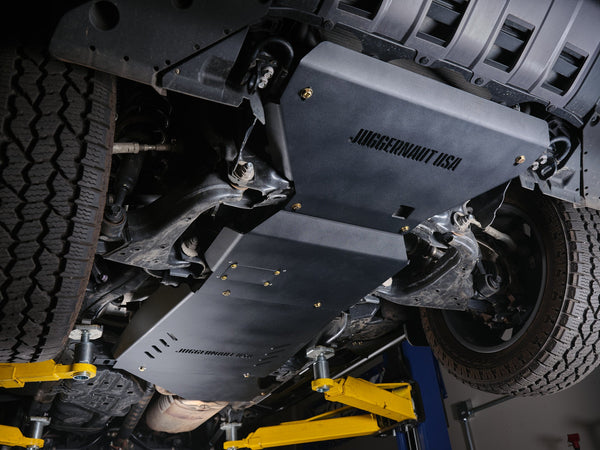
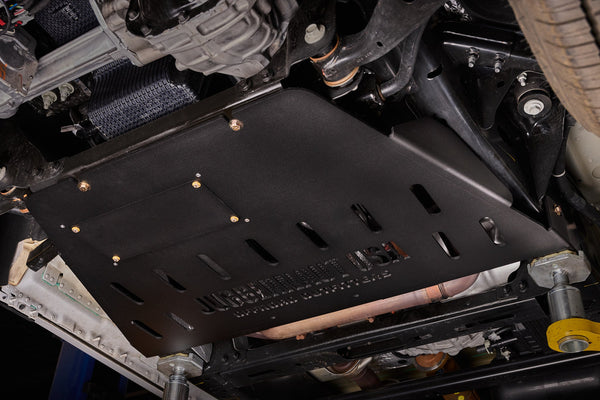
One aside: a taller lift and bigger tires expose more of the underbody to rocks, which is why a lot of lifted F-150 owners add a skid plate package at the same time — but that's a separate decision from your suspension.
Budget × performance comparison
| Tier | Real brands | Relative cost | Lift / tire | Best for | Supporting parts |
|---|---|---|---|---|---|
| Factory | Ford Performance Off-Road | $$ | Mild; 33s | Warranty peace of mind | Alignment |
| Budget / Leveling | ReadyLIFT, Rough Country, Bilstein 5100 | $ | ~1.5–2.5″; 33–34s | Daily driver, level stance | Alignment |
| Mid — coilover level | Bilstein 6112 + 5160, Eibach Pro-Truck | $$ | 0–2.5″; 35s | Best ride-per-dollar | Alignment; UCAs near top; maybe regear |
| Mid — 4–6″ lift | BDS, Zone, Fabtech, Rough Country | $$$ | 4–6″; 35s–37s | Lifted look + big tires | UCAs, alignment, CV check, likely regear |
| Premium coilover | ICON, Fox 2.5 Elite, King, Bilstein 8112, Cognito | $$$$ | 0–3.5″; 35s–37s | Real off-road, high-speed dirt | Tubular UCAs, alignment, regear |
| Mid / long-travel | Camburg, Baja Kits, SVC Offroad | $$$$$ | 0–3″ + 9–12″ travel | Pre-runner, desert builds | Fabrication, alignment, everything |
Relative cost compares tiers to each other, parts only. Installation, alignment, UCAs and a possible regear are additional. We've left hard dollar figures out on purpose — suspension pricing moves too fast for a published number to stay honest. Ask us for a current out-the-door number for your truck.
How to choose — a five-minute self-spec
1. Start with tire size, not lift height. Want 33s? A leveling kit does it. Want 35s? A 6112-class coilover or a 6″ kit. Want 37s? A 6″ kit and plan on a regear. Tire size drives the whole build.
2. Be honest about how you drive. 90% pavement and the occasional dirt road? Budget or mid-coilover. Regular high-speed dirt? That's the only case where premium coilovers earn their price. Actual pre-running? Mid-travel or long-travel.
3. Set the full budget, not the kit budget. Add UCAs, alignment, install labor and a regear on top. If the full number scares you, drop a tire size before you drop quality — a well-built smaller lift beats a cheap big one every time.
4. Don't over-lift an IFS truck. Past ~3″ of front lift you're fighting the geometry rather than working with it. If you want height for looks alone, know you're trading ride and longevity for it.
5. Match the shock to the use. Two kits at the same height can ride completely differently. A spacer rides like stock; a quality coilover rides better. If ride matters, spend it on the damper, not the height.
FAQ
Does Ford make its own lift kit for the F-150?
Yes — Ford Performance sells an Off-Road Suspension kit for the 2021+ F-150. It's mild compared with aftermarket options, but as a Ford Performance part it sits in a much friendlier position with your factory warranty. Worth considering first if the truck is leased or under warranty.
Do I need upper control arms for a leveling kit?
Usually not for a basic 1.5–2″ level. Once you're at roughly 2.5–3″+ of front lift, geometry-correcting UCAs become recommended-to-required so you can hold alignment and keep ball-joint angles sane. Many quality 3″+ kits include them.
What's the most lift I can run before it causes problems?
Ford doesn't publish a maximum, so treat this as a rule of thumb: on stock geometry ~2.5″ is the comfortable zone and around 3″ is where shops and owners start seeing CV-axle and ball-joint angles cause accelerated wear. Going taller is done with proper geometry-correcting components, not bigger spacers.
What is mid-travel, and do I need it?
Mid-travel is longer-travel shocks plus stronger upper arms at stock track width — more capability than a bolt-on kit without the fabrication, width and one-off parts of long-travel. If you wheel hard but still daily the truck, it's usually the right answer.
Do I need to regear for 35s or 37s?
For 35s it depends on how you drive and tow — many owners are happy without it. For 37s a regear is strongly recommended. We'll tell you honestly whether your combo needs one.
My truck is a PowerBoost, or has CCD. Does that change things?
Yes. PowerBoost trucks often net less lift than a kit's rating, weigh more in back, and have hybrid wiring to work around. Trucks with CCD electronic suspension are incompatible with most conventional kits — confirm fitment for your exact engine and options first.
Do you sell your own lift kit?
No — and that's the point. We install every brand here and have no kit of our own to push, so we recommend what's right for your truck, your budget and how you use it. Then we install it, add the supporting parts and align it in one shop.
Book your F-150 lift install in Wheat Ridge
Tell us your truck (engine and options), your target tire size and how you actually use it, and we'll spec the right lift — and the supporting parts to do it correctly — then install and align it at our Colorado shop. Because we don't sell a lift of our own, the recommendation is the honest one.
See our F-150 lift kit installation and F-150 leveling kit installation pages, or call (970) 341-4221, email sales@juggernautusa.com, or visit 4840 Van Gordon St Unit #300, Wheat Ridge, CO.
Armor your lifted F-150
Shop your plates below, or email sales@juggernautusa.com with your year and trim and we’ll spec it.

Skid Plate
2015-2026 Ford F-150 Transmission Skid Plate & Cat Shield
Lifetime Warranty
True Bolt-On Fit
5.0
(12)


Best value · save $229.90
Shop the package →
2015-2026 Ford F-150 Full Skid Plate Package
One part number, one box, one install afternoon.
$1,219.95$1,449.85
bought separately
Free shipping, lower 48 · guaranteed fit or we cover return shipping · cut, welded and coated in Wheat Ridge, CO
Local to the Denver metro?
We install these at our Wheat Ridge shop with a lifetime labor warranty — see F-150 lift kit installation.
Shop tip: Budget the supporting parts before you fall in love with a lift height. A 6" kit is rarely "just the kit" — once you add upper control arms, an alignment, and a possible regear for 35s, the out-the-door number can be double the box price. Decide on tire size and how you actually drive first, then pick the smallest lift that gets you there. Over-lifting an IFS truck buys you wear, not capability.
Book Your F-150 Lift Install in Wheat Ridge
We install every brand in this guide at our Colorado shop and spec your lift honestly around your budget and how you use the truck — daily driver, tow rig, or trail build. Call (970) 341-4221, email sales@juggernautusa.com, or stop by 4840 Van Gordon St Unit #300, Wheat Ridge, CO. We'll handle the lift, the supporting parts and the tire fit, and arrange the alignment.