Skid Plate Myths: Warranty, Overheating, MPG, Rust and More.
Straight answers to common skid plate myths: warranty, overheating, fuel economy, rust, catalytic converter protection, plates falling off, and splash shields.
A skid plate does not void your whole warranty; in the US a dealer has to show the part caused the failure to deny that claim. A plate designed with airflow in mind does not cause overheating. The mpg effect from added weight is small. Rust risk depends on material, coating and drainage. A splash shield is not a skid plate.
Most skid plate myths start from something real that got turned into a rule. Below is each one, what actually holds up, and what to check on the plate you are looking at.
Jump to: Myths at a glance · Warranty · Overheating · MPG · Rust · Catalytic converter · Falling off · Splash shield · FAQ

Myths at a glance
| Myth | Short answer | What to check |
|---|---|---|
| Skid plates void your warranty | No, not by themselves | Keep install records; a dealer must tie a failure to the part |
| Skid plates cause overheating | Not when the design leaves airflow paths | Vents or openings near the oil pan and transmission |
| Skid plates kill fuel economy | Effect is small | Total added weight; plates sit flat under the frame |
| Skid plates cause rust | Depends on material, coating and drainage | Coating, drain paths, how often you rinse the underside |
| Skid plates protect the cat | Only if the plate covers the cat | Coverage drawing for your truck |
| Skid plates fall off | Not when installed and torqued correctly | Hardware grade, torque, re-check after first trail use |
| A splash shield is a skid plate | No | Material: plastic or thin sheet vs structural plate |
Myth: a skid plate voids your warranty
In the US, the Magnuson-Moss Warranty Act means a manufacturer generally cannot void your whole warranty because you installed an aftermarket part. If a covered part fails, the dealer can deny that specific claim if they show the aftermarket part caused the failure (FTC: auto warranties). A plate bolted to factory mounting points is unlikely to cause a mechanical failure, but a service advisor may still ask about it.
What helps: keep your receipt and install notes, use factory mounting points where the plate is designed for them, and keep any factory parts you removed. If a dealer needs to get to the oil pan or transmission, they can unbolt the plate.
Myth: skid plates cause overheating
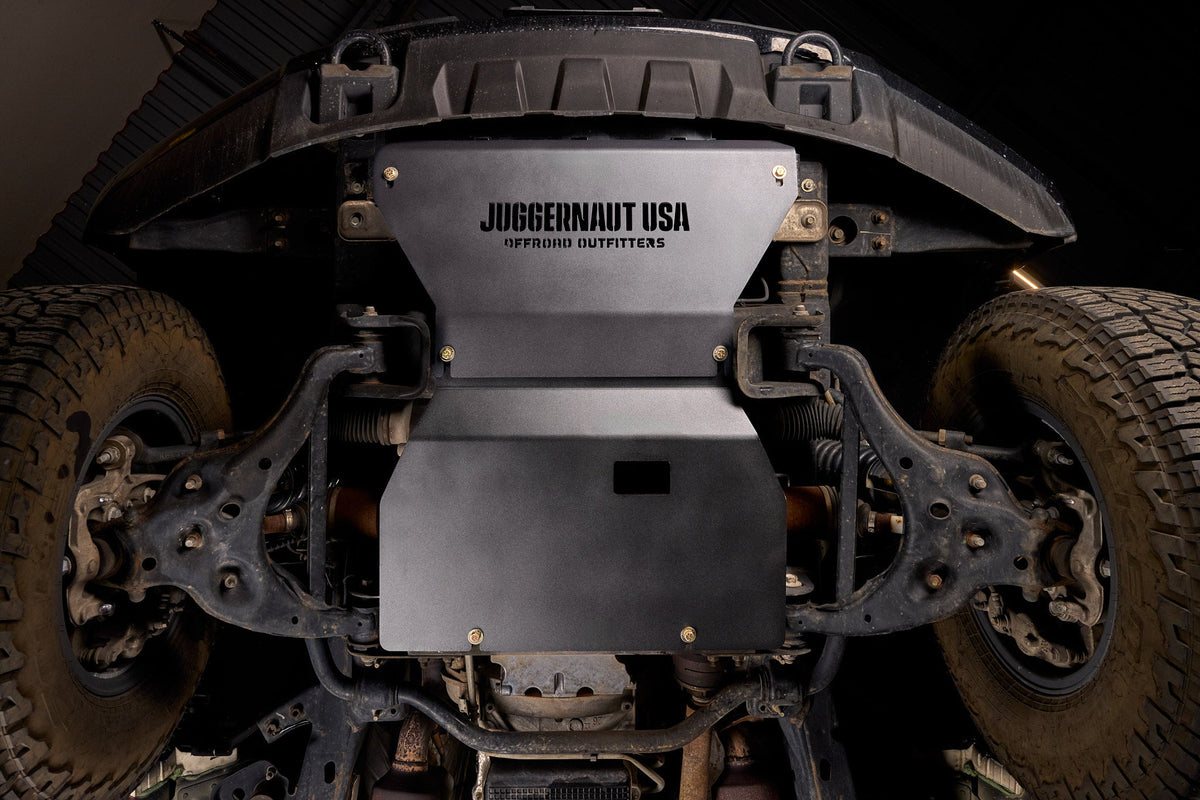
A flat, solid sheet tight against the oil pan and transmission could trap heat. That is why plate design matters. Plates that leave space between the plate and the component, and that have openings where air needs to move, let heat escape the way the factory intended.
Check how the plate is shaped and where the openings are before you buy.
Myth: skid plates kill your fuel economy
Added weight costs some fuel, and the effect scales with how much weight you add. A set of aluminum plates adds far less weight than the same coverage in steel, which is one reason we build in aluminum. See our guide on aluminum vs steel skid plates for the weight comparison.
Some people expect a flat underside to improve aerodynamics. That can be true on a vehicle designed around a full belly pan, but on a truck the effect either way is small. We do not make an mpg claim for our plates.
Myth: skid plates cause rust
Any plate under a truck can hold mud, salt and water against the frame if it has no way to drain. Bare steel plates also rust themselves once the coating chips. Aluminum does not rust the way steel does. It can still corrode on the surface, and where aluminum touches steel brackets or hardware in road salt, galvanic corrosion can start at the contact point. Powder coat adds a barrier on top.
The practical advice: pick a plate that drains, rinse the underside after salted roads or mud, and pull the plates occasionally to clean behind them.

Myth: any skid plate protects your catalytic converter
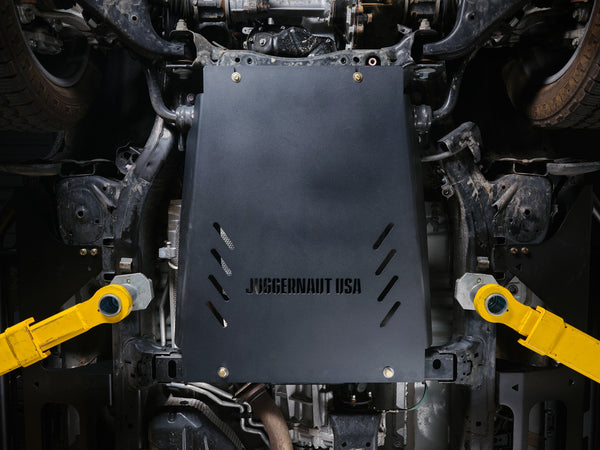
A skid plate protects what it covers. An engine plate covers the engine and oil pan. Whether a transmission plate also covers the catalytic converters depends on the truck and the plate design. If theft protection is your main goal, look for a plate built to cover the converters and check the coverage drawing for your exact vehicle.
See catalytic converter protection and our guide to how converter shields work.
Myth: skid plates fall off
A plate falls off when hardware is undersized, under-torqued, or threads into stripped or rusted mounting points. A plate installed with the right hardware at the right torque stays put. Our hardware is Grade 8 steel.
Re-check bolt torque after the first trail run or after a hard hit. Rusty factory threads should be cleaned before install. Follow the install instructions that come with your plate.
Myth: a splash shield is a skid plate
Most trucks leave the factory with a plastic splash shield or a thin stamped cover under the engine. That part keeps water, road spray and small debris out of the engine bay. It is not built to take the weight of the truck landing on a rock. A skid plate is structural: it is meant to take a strike and let the truck slide over the obstacle.
Some off-road trim packages do add real steel skid plates from the factory. Factory vs aftermarket skid plates covers how they compare.

How we build ours
Our plates are 1/4" 5052-H32 aluminum, cut, formed, welded and powder coated in our Wheat Ridge, Colorado shop, and backed by our Limited Lifetime Manufacturer's Warranty.
Shop by truck: Ford F-150, Toyota, Super Duty.
FAQ
Can a dealer refuse to work on a truck with skid plates?
A shop can ask you to remove a plate or charge to remove it for access. That is a labor question, separate from whether a warranty claim is covered.
Does a skid plate change ground clearance?
The plate sits under the parts it protects, so it can be the lowest point in that spot.
What does corrosion on an aluminum plate look like?
A dull white or gray film, usually where the coating is chipped. It does not flake through the way rust does on steel.
Our most popular plate sets
Shop your plates below, or email sales@juggernautusa.com with your year and trim and we’ll spec it.


Coverage beats claims. Check which components a plate covers on your exact year and drivetrain before you buy.
1/4 inch 5052-H32 aluminum, MIG welded and powder coated in Wheat Ridge, Colorado.