Shop floor · Wheat Ridge, CO
How to Choose Tacoma Skid Plates: TRD vs. Aftermarket, by Generation.
The factory TRD skid plate is decent 1/4″ aluminum — but it's front-only, leaving your transmission, transfer case, cats, and fuel tank exposed. Full coverage means adding plates behind it, and fitment depends on your generation and KDSS.
The short version
The factory TRD plate is decent 1/4″ aluminum, and it is front-only. The transmission, transfer case, converters and fuel tank behind it are uncovered.
Full coverage means adding plates rearward, and fitment splits by generation and by whether the truck has KDSS — confirm both before buying anything.
We build 4th-gen Tacoma plates for 2024 to 2026 and do not make 3rd-gen ones yet.
1/4″
5052-H32 aluminum
Front-only
Factory TRD coverage
Lifetime
Warranty
2016+
3rd & 4th gen
If your Tacoma only has the factory TRD skid plate, most of your underbody is still bare. That plate covers the front — your transmission, transfer case, and fuel tank are exposed to the first rock you find. This guide covers the 2016–2026 Tacoma: what's actually at risk underneath, what the factory TRD skid plate does and doesn't protect, how it differs by generation, and what separates real, full-underbody armor from a front-only cover. We build 1/4″ aluminum skid plates in Colorado. Driving a 2024–2026? Shop our 2026 Tacoma skid plates or see every 4th-gen option compared.
Jump to what's exposed, the TRD skid plate, by generation, how to choose, or our Tacoma lineup.
What's exposed under a Toyota Tacoma
The Tacoma is one of the most capable mid-size trucks off the lot — which means owners actually take them where the underbody takes hits. These are the components hanging low and in harm's way:
- Engine oil pan — low and forward; a rock strike here can crack the pan and end the day, or the engine.
- Transmission & crossmember — exposed across the mid-belly.
- Transfer case — the 4WD hardware hangs low and is expensive to replace.
- Fuel tank — sits exposed toward the rear; a puncture is a tow at best.
- Lower control arms — vulnerable on technical terrain.
On a stock Tacoma, almost none of this is covered. Even the TRD Off-Road and TRD Pro trims — which add a factory skid plate — only protect part of it. More on that next.
The factory TRD skid plate — and what it misses
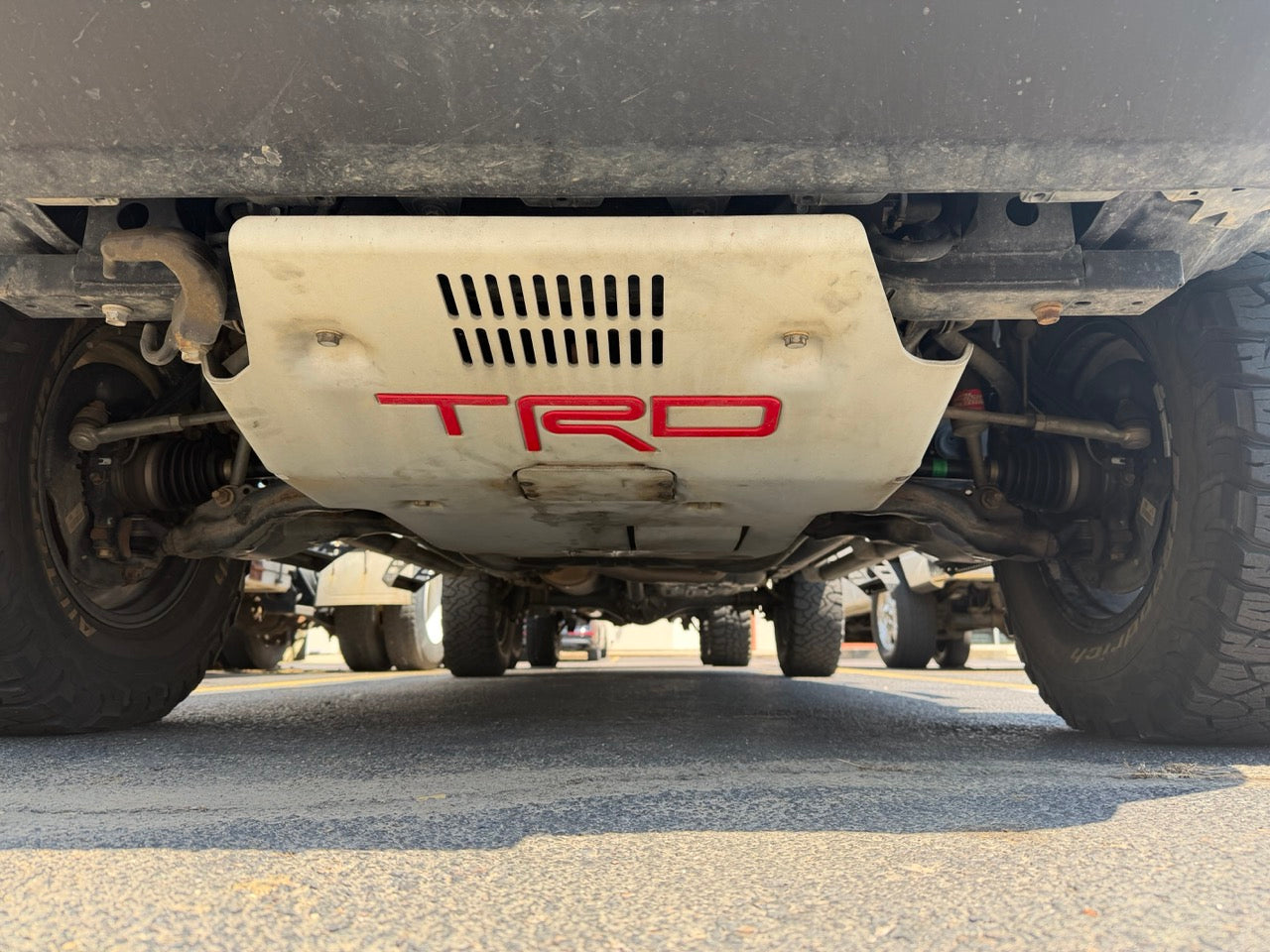
This is the part most Tacoma owners get wrong — in both directions. The factory “TRD skid plate” (the front plate on TRD Off-Road and TRD Pro trims, or the bolt-on accessory — Toyota part PTR60-35190 for 2016–2023 and PTR60-35240 for 2024+) is actually ~1/4″ stamped aluminum. On thickness and material it's in the same ballpark as good aftermarket plates — it's not the flimsy cover some people assume.
Its limitation isn't the plate. It's how little of your truck it covers. The TRD skid plate is front-only — it protects the front of the engine and oil-pan area and stops there, leaving exposed:
- The catalytic converters and exhaust — both an impact target and a theft target
- The transmission and crossmember
- The transfer case
- The fuel tank — from the factory this usually has only a thin plastic shield, not a skid plate

(Lower, non-TRD trims that have any factory plate use thinner stamped steel.) The TRD piece is also a single formed front plate, not a full flat-plate system.

Bottom line: the TRD plate is a good start, not a full underbody solution. The gap isn't its thickness — it's coverage.
Here's the same comparison in one view — the factory TRD front plate against a full-coverage system:
| What decides it | Juggernaut 4th-gen system | Factory TRD front plate |
|---|---|---|
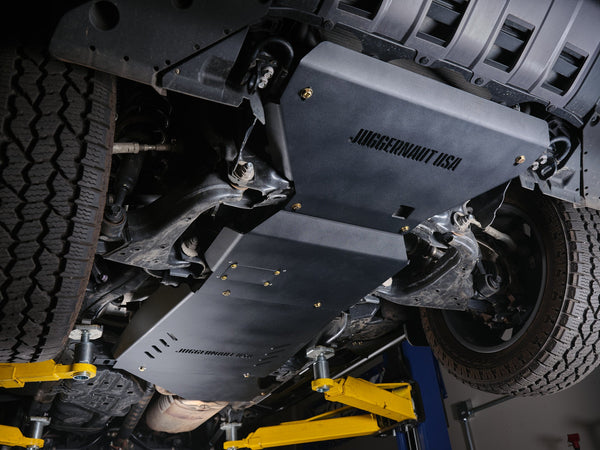
| What it covers | Engine, transmission (incl. the sway-bar disconnect on equipped trims), and transfer case | Front of the engine / oil-pan area only |
| Thickness & material | 1/4″ 5052-H32 plate aluminum | ~1/4″ stamped aluminum — solid, but one plate |
| Fuel tank | Not in the lineup yet — demand decides what we build next | Thin plastic factory shield stays as-is |
| Finish | Powder-coated black, standard | Factory finish |
| Mounting | Bolt-on to factory points, no drilling | Factory accessory bolt-on |
| Warranty | Limited Lifetime Manufacturer's Warranty | Standard accessory warranty |
Tacoma skid plates by generation
Skid plates are generation- and often trim-specific, because Toyota changed the frame and underbody between generations. The two that matter for current buyers:
3rd gen (2016–2023). The long-running Tacoma with the deepest aftermarket support. The TRD Off-Road came with a front skid; the rest of the underbody is open for aftermarket coverage. Many 3rd-gens have KDSS (Toyota's kinetic sway-bar system), which changes skid-plate fitment — confirm whether your truck has it before ordering anything. For the full 2016–2023 breakdown — what each trim actually ships with and how thin the factory coverage runs — see the 3rd gen Tacoma skid plates guide.
4th gen (2024+). The new platform (i-FORCE / i-FORCE MAX hybrid) rides on a different frame and underbody layout, so 3rd-gen plates do not fit. Higher trims (TRD Off-Road, Trailhunter, TRD Pro) come with more factory skid coverage than past Tacomas — but it's still partial, and the transfer case and fuel tank are the usual gaps. Confirm exactly what your trim came with.
If you're shopping, the first thing to nail down is your exact year, trim, and whether you have KDSS — that's what determines which plates fit. Once you know you're on a 4th gen, everything that fits it is in the 2026 Tacoma skid plates collection.
How to choose Tacoma skid plates (what actually matters)
The Tacoma armor market is crowded, and the products are not equal. Here's what separates real protection from a cheap cover — the six things to check before you buy:
- Coverage. This is the big one. Does it actually protect the transmission, transfer case, and fuel tank — or just repeat the front-only coverage the TRD plate already gives you? Look for a system, not a single front plate.
- Thickness. A lot of “skid plates” are 3/16″ (0.1875″ / 4.76mm) or thinner — some are just 3.5mm steel, barely heavier than a factory stamping. 1/4″ (0.250″ / 6.35mm) is the thickness that resists a hard hit without permanently deforming. That extra 1/16″ over the common 3/16″ plate matters more than it sounds, because a plate's resistance to bending climbs with the square of its thickness.
- Material & alloy. Steel is strong but heavy and rusts; thin aluminum dents. The sweet spot is 1/4″ 5052-H32 aluminum — marine-grade, flexes and recovers, and can't rust. Be wary of listings that just say “aluminum” with no grade. Here's the full aluminum vs. steel breakdown.
- Finish. A surprising number of plates ship as bare metal — you pay extra (or DIY) to powder-coat them so they don't rust or look rough in a month. Powder-coated as standard is what you want.
- Serviceability. Oil-drain and filter-access cutouts mean you're not pulling the plate every oil change.
- Warranty. Much of the market offers only a 1-year warranty on what's supposed to be permanent armor. A real lifetime warranty tells you the maker stands behind it.
Run any Tacoma skid plate against those six and the gap between “real armor” and “a thin cover that looks like armor” gets obvious fast. Ready to compare actual products? Our best 4th-gen Tacoma skid plates comparison runs every serious system — ours and our competitors' — through exactly that checklist.
Juggernaut Tacoma skid plates — now shipping for the 4th gen
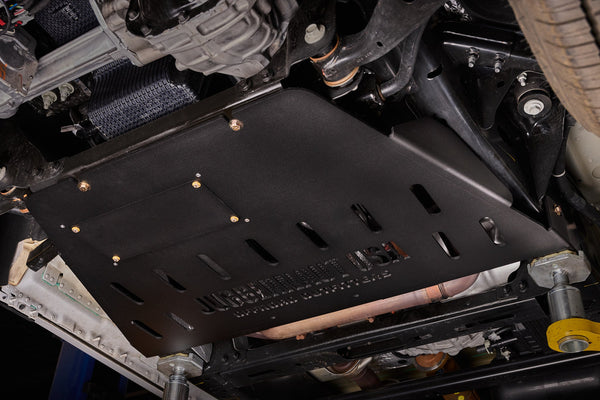
We manufacture 1/4″ 5052-H32 aluminum skid plates in Wheat Ridge, Colorado — CNC-cut, press-brake folded, powder-coated as standard, bolt-on with no drilling, and backed by our Limited Lifetime Manufacturer's Warranty. Where the factory TRD plate stops at the front, our 2024–2026 4th-gen Tacoma line covers the drivetrain behind it — engine, transmission (including the electronic sway bar disconnect on equipped trims), and transfer case.
A fuel tank plate isn't in the lineup yet — customer demand is how new plates get made here, so if you want one, tell us.
Own a 6th-gen 4Runner as well? The 2025+ 4Runner is built on the same TNGA-F platform as the 4th-gen Tacoma, and the mounting points line up — so the same plates fit it. See our 2025–2026 Toyota 4Runner skid plates.
The spec we build every plate to:
| Spec | Juggernaut Tacoma plates |
|---|---|
| Plate thickness | 1/4″ (0.250″ / 6.35mm) |
| Material | 5052-H32 marine-grade aluminum |
| Finish | Powder-coated black (standard) |
| Mounting | Bolt-on to factory points, no drilling |
| Serviceability | Oil-drain & filter-access cutouts |
| Warranty | Limited Lifetime Manufacturer's Warranty |
| Made in | Wheat Ridge, Colorado, USA |
Driving a 3rd gen (2016–2023)? Those plates are still in development. Email sales@juggernautusa.com with your year, trim, and whether you have KDSS, or call/text (970) 341-4221 — we'll put you on the 3rd-gen list and notify you the day they ship.
Frequently asked questions
How thick is the factory TRD skid plate?
Toyota's TRD front skid plate (parts PTR60-35190 and PTR60-35240) is about 1/4″ stamped aluminum — solid for a front plate. The catch isn't thickness, it's coverage: it only protects the front, leaving the catalytic converters, transmission, transfer case, and fuel tank exposed.
Does a Toyota Tacoma come with a skid plate?
Base trims have little to no underbody protection. TRD Off-Road, Trailhunter, and TRD Pro trims add a factory front skid plate, but it's front-only — the transmission, transfer case, and fuel tank are typically still exposed (the fuel tank often has only a thin plastic shield).
Can you put a TRD skid plate on a regular Tacoma?
Yes — the TRD front skid plate is available as a Toyota accessory and bolts to non-TRD trims. Just know it only covers the front; for full coverage you'll still want transmission, transfer-case, and fuel-tank plates. On a 4th gen, our skid plate package covers the drivetrain behind it.
Is the TRD Pro skid plate different from the TRD Off-Road one?
The front plates vary a little by trim and year — the TRD Pro's carries its own styling — but functionally they do the same job: protect the front of the engine area. Whichever trim you have, the coverage gap is identical. The transmission, transfer case, and fuel tank behind the plate are still open.
Do Tacoma skid plates fit the 2025 Tacoma?
Yes. The 2024, 2025, and 2026 Tacomas all share the 4th-gen platform, so every plate in our 2024–2026 Tacoma collection fits all three model years. Confirm your trim on the product page — the electronic sway-bar disconnect on some trims is accounted for in the transmission plate fitment.
Are Tacoma and 4Runner skid plates the same?
For the current trucks, yes. The 4th-gen Tacoma (2024+) and the 6th-gen 4Runner (2025+) are both built on Toyota's TNGA-F platform and the mounting points line up, so our 4Runner skid plates are the same design we cut for the Tacoma. Across older generations they aren't interchangeable — the frames and underbody layouts differ — so order for your exact vehicle and generation.
What thickness should a Tacoma skid plate be?
1/4″ (0.250″ / 6.35mm) is the standard for real impact protection. Many cheaper aftermarket plates are 3/16″ (4.76mm) or thinner steel — they add weight without matching the strength of 1/4″ aluminum.
Aluminum or steel for a Tacoma?
For most owners, 1/4″ 5052-H32 aluminum — it resists bending, weighs about half as much as steel, and won't rust. Steel is cheaper and slightly better against constant abrasion. See our aluminum vs. steel guide.
Protect your Tacoma
3rd gen (2016–2023): email sales@juggernautusa.com or call/text (970) 341-4221 with your year and trim, and we'll notify you the day they ship.
Armor your Tacoma
Shop your plates below, or email sales@juggernautusa.com with your year and trim and we’ll spec it.


Best value · save $229.90
Shop the package →
2024-2026 Toyota Tacoma Full Skid Plate Package
One part number, one box, one install afternoon.
$1,249.95$1,479.85
bought separately
Free shipping, lower 48 · guaranteed fit or we cover return shipping · cut, welded and coated in Wheat Ridge, CO
Already have the TRD skid? It only covers the front. Your transmission, transfer case, and fuel tank are still exposed — here's how to armor the rest.
Get on the Tacoma armor list
1/4″ aluminum skid plates for the 2024–2026 Tacoma are shipping now — engine, transmission and transfer case, bolt-on, made in Colorado. 3rd gen owners: email your year and trim and we'll notify you when yours ship.