3rd Gen Tacoma Skid Plates (2016–2023): What the Factory Plate Misses.
We build 4th-gen Tacoma plates and do not make 3rd-gen ones yet. The factory TRD plate is good 1/4″ aluminum and it is front-only — here is what stays exposed, what the market sells, and the KDSS and diff drop traps.
The factory TRD plate (Toyota PTR60-35190) is roughly 1/4″ stamped aluminum — good material, and the same thickness class as quality aftermarket plate. Its limit is reach: it covers the front of the engine and oil pan and stops.
So on most 3rd gens, keep it and add coverage behind it, starting with the transfer case.
Check whether your truck has KDSS before ordering, since some plates come in KDSS-specific versions. And read components rather than the word kit — of the three main kits, one includes the fuel tank and two sell it separately.
We make skid plates for the 4th-gen Tacoma. We do not make them for the 3rd gen yet. So there is no 2016–2023 part for us to sell you on this page. We build this kind of part, and we install other manufacturers' versions of it in our shop most weeks, which is where the following comes from.
The 3rd gen is a good platform to armor: body-on-frame, real crossmembers, and one of the deepest aftermarket catalogs in off-road. Two things about it are widely misunderstood — what the factory plate actually is, and one fitment detail that costs people money.
Jump to: What the factory gives you · KDSS and fitment · Diff drop clearance · What stays exposed · What the market sells · How to judge a kit · FAQ
What the factory gives you
The factory skid plate is good for the front of the truck, and it misses important items behind it.
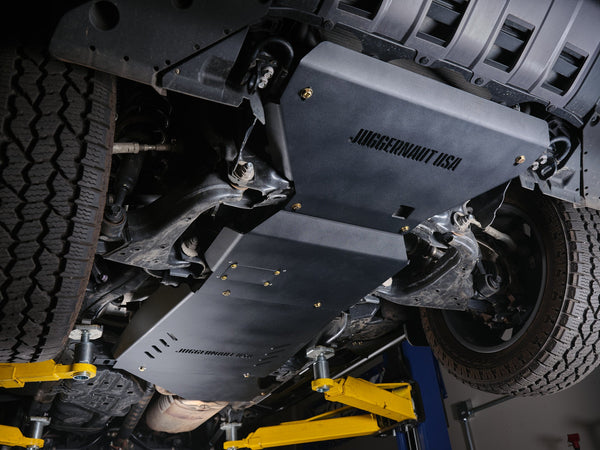
Credit where it is due on the material. The TRD front skid plate — Toyota part PTR60-35190, standard on TRD Off-Road and TRD Pro, available as a dealer accessory on other trims — is roughly 1/4″ stamped and formed aluminum. That is the same thickness class we cut our own plates from, and it is a genuinely capable part for what it covers.
What it covers is the front of the engine and the oil-pan area. Behind that, these are uncovered:
- Catalytic converters and exhaust
- Transmission and crossmember
- Transfer case
- Fuel tank
For most 3rd-gen owners that means the factory plate is worth keeping, and the money goes on coverage behind it rather than on replacing the front.
KDSS and fitment
Many 3rd-gen Tacomas, generally TRD Off-Road and TRD Pro, came with KDSS — Toyota's Kinetic Dynamic Suspension System. It routes hydraulic lines and a valve body through the area a skid plate occupies.
Two things follow. Some plates are sold in KDSS and non-KDSS versions, so the part number matters. And where a plate is listed as fitting both, ask about clearance around the KDSS hardware under suspension flex — a plate that contacts a hydraulic line is worse than no plate.
To check your own truck, look behind the front wheels for hydraulic lines and a valve block mounted near the frame.
Diff drop clearance
If your truck is lifted, or you are planning to lift it, ask about this before you buy a front or engine plate.
The Tacoma has independent front suspension. Lifting the front steepens the CV axle angles, and the usual fix is a differential drop kit, which lowers the front diff on spacers to bring those angles back toward stock. That puts the differential lower than it was, and it puts the drop brackets in the same space near the front crossmember that a skid plate wants to use.
Two things go wrong. The plate will not bolt up because the drop brackets are occupying its mounting points. Or it bolts up, but the relocated diff sits close enough that it contacts the plate under articulation.
Manufacturers differ on this and some list a plate as incompatible with a diff drop outright. Ask directly: does this plate clear a diff drop, and whose? It is a specific question with a specific answer, and it is much cheaper to ask than to find out on the ramp.
Where the money goes
Buying in stages, the order follows what the factory plate does not reach.
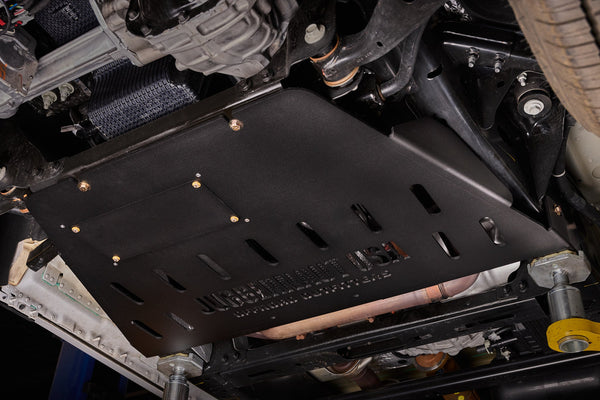
1. Transfer case. It hangs low, sits in the path of anything you straddle, and costs several times a plate to replace. On a truck that already has the TRD front plate, this is the first gap.
2. Transmission and crossmember. Directly behind the factory plate, and the next thing a rock reaches after clearing the front end.
3. Fuel tank. Large, flat, and in the middle of the truck where breakover puts it. On a double cab the span between the axles is significant.
4. Catalytic converter. On a Tacoma this covers two risks — impact and theft. The Tacoma has been on national converter-theft target lists for years, and ride height is the reason: a thief can get underneath without a jack. Our cat shield explainer covers what stops the cut.
On a base SR or SR5 with no factory plate, the front moves to the top of that list.
What the market sells
There is good product available for this truck. What differs between the serious options is material choice and how much of the underbody a kit covers. Checked against the manufacturers' own live listings in July 2026.
| Brand | Material | What a multi-plate kit covers | Also sold separately |
|---|---|---|---|
| RCI Off Road | 3/16″ steel or 1/4″ aluminum | Engine, transmission, transfer case, fuel tank | Cat guard, rear diff, A-arms, rear shock mounts |
| C4 Fabrication | 3/16″ steel | Engine, transmission, transfer case (3-piece) | Fuel tank, rear skids, rear diff |
| Talons Garage | 1/4″ 5052 aluminum or 3/16″ steel | Engine, transmission with cat shield, transfer case | Welded reinforcing ribs option |
Others serving this platform include BudBuilt, a long-standing Toyota-only armor specialist, along with Artec Industries, Backwoods Adventure Mods, Rival 4x4 and Cali Raised. We have not verified their current specifications, so use their listings rather than this table.
Two things to take from it.
Both materials are widely available on this platform. Steel and 1/4″ aluminum are both easy to buy for a 3rd gen, so the material decision is an engineering trade-off rather than a question of what is on offer.
"Kit" does not describe coverage. Of the three above, one includes the fuel tank and two sell it separately, and all three are sold as kits. Write down the components you want and check them against the listing before ordering.
How to judge a 3rd-gen kit
Thickness and material apply to any vehicle, and we cover that trade-off properly in the aluminum versus steel comparison. The short version: 3/16″ in steel or 1/4″ in aluminum as a floor, and anything at 1/8″ or below is a debris cover whatever the listing calls it.
Four things are specific to this truck.
Count components, not plates. This is the most common reason people end up with less coverage than they expected.
Confirm the KDSS version. Ask about the part number rather than the trim.
Ask about diff drop clearance if the truck is lifted or going to be.
Weigh it against the fact that this is usually a daily driver. Full steel coverage from the front to the fuel tank adds real mass to a truck that was not oversupplied with power, and it all sits below the roll center. On a Tacoma specifically that is the strongest argument for aluminum, and it is about how the truck drives every day rather than how the plate survives one bad line.
Where we stand
We make 1/4″ 5052-H32 aluminum skid plates in Wheat Ridge, Colorado — CNC plasma cut, press-brake folded, MIG welded, powder coated, lifetime manufacturer's warranty. Our Tacoma coverage is the 4th gen, 2024–2026 — everything that fits it is in the 2024–2026 Tacoma skid plates collection, and the generation-by-generation picture is in the Toyota Tacoma skid plates guide.
We also run a 4x4 install shop, and plates from most of the brands above come through our bays on customers' trucks. That is where the practical parts of this page come from — which brackets line up, which fasteners seize into a poorly coated plate, what happens when a plate meets a diff drop, and what it takes to get an oil change done on a truck whose armor has to come off first.
The 3rd gen is the platform we get asked for most and do not build yet. We do not have a date to give you. If you want to hear when there is something to look at, email us and we will note the platform.
FAQ
Do you make 3rd-gen Tacoma skid plates?
Not yet. Our Tacoma coverage is the 4th gen, 2024–2026.
Is the factory TRD skid plate any good?
Yes, for what it covers. Toyota part PTR60-35190 is roughly 1/4″ stamped aluminum, the same thickness class as quality aftermarket plate. It protects the front of the engine and oil pan and misses the converters, transmission, transfer case and fuel tank behind it.
Should I remove the factory plate to fit an aftermarket one?
Usually not. Since it is good material and only covers the front, the sensible approach is to keep it and add transmission, transfer case and fuel tank coverage behind it. Check whether the kit you are considering replaces or supplements it.
What should I buy first?
With the TRD front plate: transfer case, then transmission, then fuel tank, then the cat shield. Without it: front first.
Does KDSS affect skid plate fitment?
Yes. It routes hydraulic lines through the area a plate occupies, and some plates come in KDSS-specific versions. Confirm the part number before ordering and ask about clearance under flex.
Will a skid plate work with a diff drop kit?
Ask the manufacturer, because it varies and some plates are listed as incompatible. A diff drop lowers the front differential on spacers to correct CV angles after a lift, which both occupies mounting points near the front crossmember and brings the diff closer to the plate under articulation.
Can you install skid plates for me?
Yes, if you can get to Colorado. We run a 4x4 install shop in Wheat Ridge and fit armor from other manufacturers as well as our own.
Is the Tacoma targeted for catalytic converter theft?
It has been on national target lists for years. Ride height is the main reason. A plate needs to cover the pipe on both sides of the converter, not just the converter body, to block the cut.
Steel or aluminum on a 3rd gen?
Both are available and both are defensible. Bend resistance scales with the square of thickness, so 1/4″ aluminum out-resists 3/16″ steel at roughly half the weight and does not rust. Steel resists gouging better under repeated abrasion. On a daily-driven Tacoma, weight is the strongest consideration.
How thick should it be?
3/16″ in steel or 1/4″ in aluminum as a floor. Below 1/8″ is a debris cover.
Will 4th-gen plates fit a 3rd gen?
No. Toyota redesigned the truck for 2024 and the underbody and mounting points differ.
If your 3rd gen has the TRD front plate, keep it. It is already 1/4″ aluminum, so replacing it with an aftermarket front skid buys little. Put the money into the transfer case and transmission instead, which is where factory coverage runs out.
We are a manufacturer and a 4x4 install shop, which is uncommon in this category. We fit other brands' plates as well as our own, and we build 1/4″ 5052-H32 aluminum armor for the 4th-gen Tacoma.